
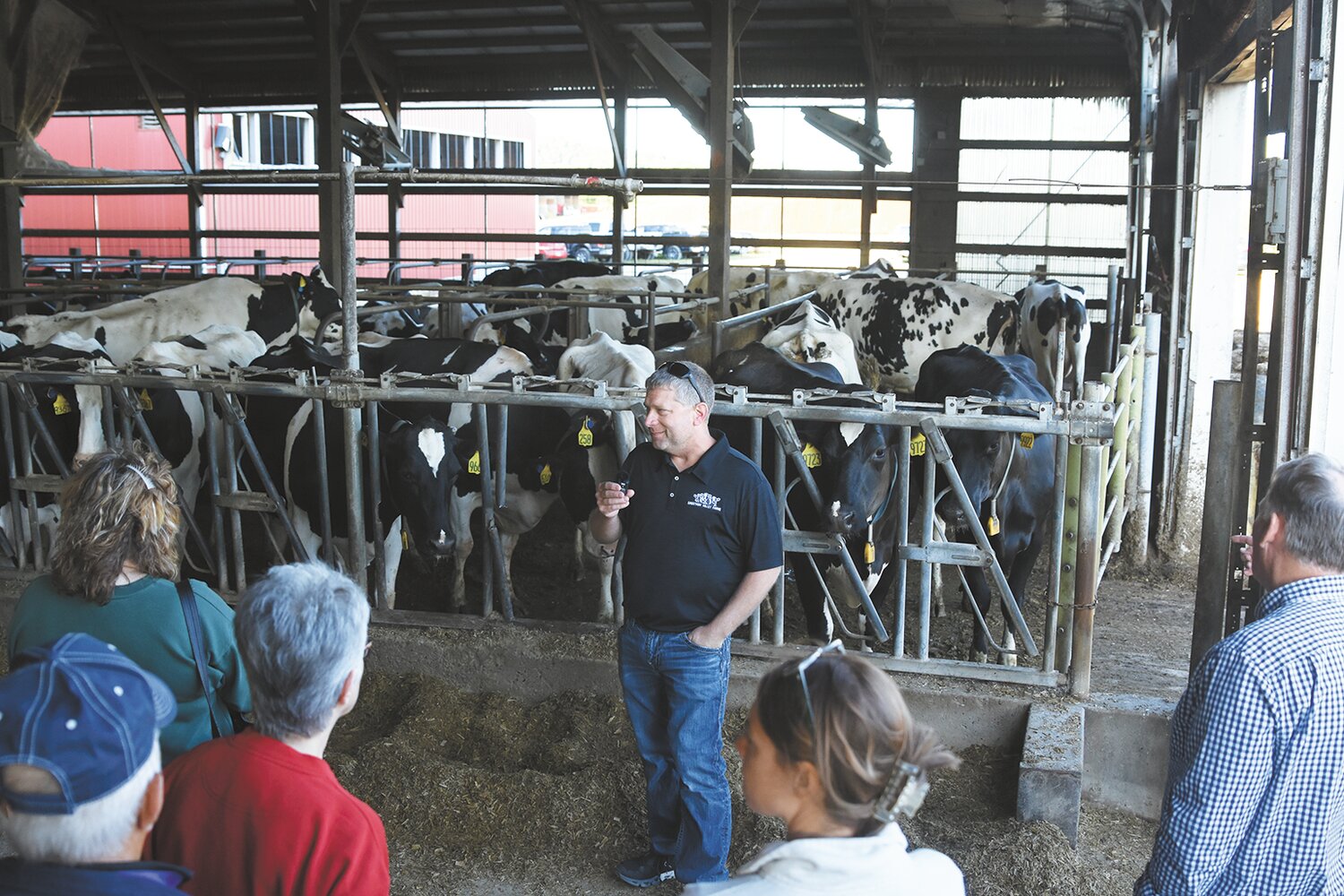
DURAND, Wis. — Professional Dairy Producers hosted a string of Agricultural Community Engagement Twilight Meetings at four locations across the state during the last week of August. Lindstrom Valley Farms near Durand kicked off the series, hosting fellow dairy farmers and industry professionals for a night of communication and development Aug. 25, beginning at 6 p.m.
“It was nice to have people on our farm and give a tour,” Deric Lindstrom said. “The question-and-answer session that was here had more connection, and people could get more answers from industry experts .”
Those onsite experts included representatives from PDP, the Wisconsin Towns Association, the Wisconsin Counties Association, Compeer Financial, the dean of the University of Wisconsin-River Falls College of Agriculture, Food and Environmental Sciences, the Wisconsin Department of Agriculture, Transportation and Consumer Protection, as well as the Department of Natural Resources.
The evening started with a tour of Lindstrom Valley Farms — a fifth-generation dairy owned by Deric, Randy, Becky and Andrew Lindstrom and Nora Gilles. Siblings Deric, Andrew and Gilles farmed with Randy and his brothers for several years and are transitioning ownership to the younger generation. The family milks 1,400 cows, primarily Holsteins, at two locations and raises heifers and calves.
The dairy that hosted the event milks in a double-16 parlor; the other facility has a double-8 parallel parlor. The second location was acquired from neighbors who were nearing retirement. Lindstrom Valley Farms purchased the cows and began renting the milking facility.
“In the future, we’ll probably build a new parlor,” Deric Lindstrom said. “We’d like to have all the milking cows on the same farm, but for now this setup works for us.”
The farm grows close to 2,400 acres of crops, renting over 700 acres from neighbors and purchasing hay from neighbors in the Nelson and Durand area. The farm stores 1,200 acres of corn silage at its expanded feed pad and features a 100,000-gallon runoff water pit.
“We put the pit in to collect as much water as we can when it rains,” Lindstrom said. “We mix that rainwater that we collect with our manure and treat it like manure.”
The feed pad area with commodity storage, the freestall barn and the farm’s sand reclamation system were highlights of the tour.
Within the commodity area, Lindstrom and Gilles each led tours, discussing their strategies of using cover crops in the winter, but not feeding those crops. They also discussed feeding ground straw to dry cows, feeding canola, the use of the farm’s hammer mill within the commodity area and how a premix area improves feeding efficiency.
The sand reclamation area helps separate waste fiber from used bedding. After separation, the sand sits for 3-4 days before being used for bedding again in the freestall barn. Through use of a sand reclamation system, the farm has dramatically cut down on the amount of sand needed, saving money and trucking.
“We currently buy 12 loads of sand a year,” Lindstrom said. “Before the system, we were buying 25 loads of sand a week. There was a lot of wear and tear on the roads and the infrastructure around the farm. This system is far more efficient.”
Following the tour, attendees were welcomed to an ice cream sundae as PDP began its programming and question-and-answer session. Lindstrom spoke about the importance of welcoming not just other dairy farmers to his farm, but also for the public to see the background of a dairy farm.
“I want to bring awareness to what we do,” Lindstrom said. “Not everyone gets on farms these days and can see it. I think people driving by a farm don’t realize all the management and what goes into producing (milk) at a dairy.”
Along with lifting back the curtain and giving people a look at the management within a farm, it was also important to Lindstrom to show the level of care that goes into a dairy farm.
“I want people to learn how much we care about the cows and the land,” Lindstrom said. “For us, it’s a business, but it’s also a way of life. I’ve seen a lot of changes in my life in dairy, and I feel very fortunate to have grown up in this style of life. I think my kids appreciated it.”
To keep up with continued expansion of the family farm, the Lindstroms constructed their freestall barn in stages. Now housing 900 cows, construction began in 2009, and the barn was expanded three more times, finishing additions in 2011, 2015 and 2021. The freestall barn is tunnel ventilated and includes a maternity area.
Lindstrom spoke about the importance of continuing to expand and improve facilities, which benefits not only their family, but each of their 32 employees and the surrounding community as well.
“If you don’t keep reinvesting in your dairy, it seems like that would be the end of it,” Lindstrom said. “You put an end date on it if you don’t continue to look towards the future and make those advancements.”
 |
 |
 |
 |
Share with others


Comments
No comments on this item Please log in to comment by clicking here