
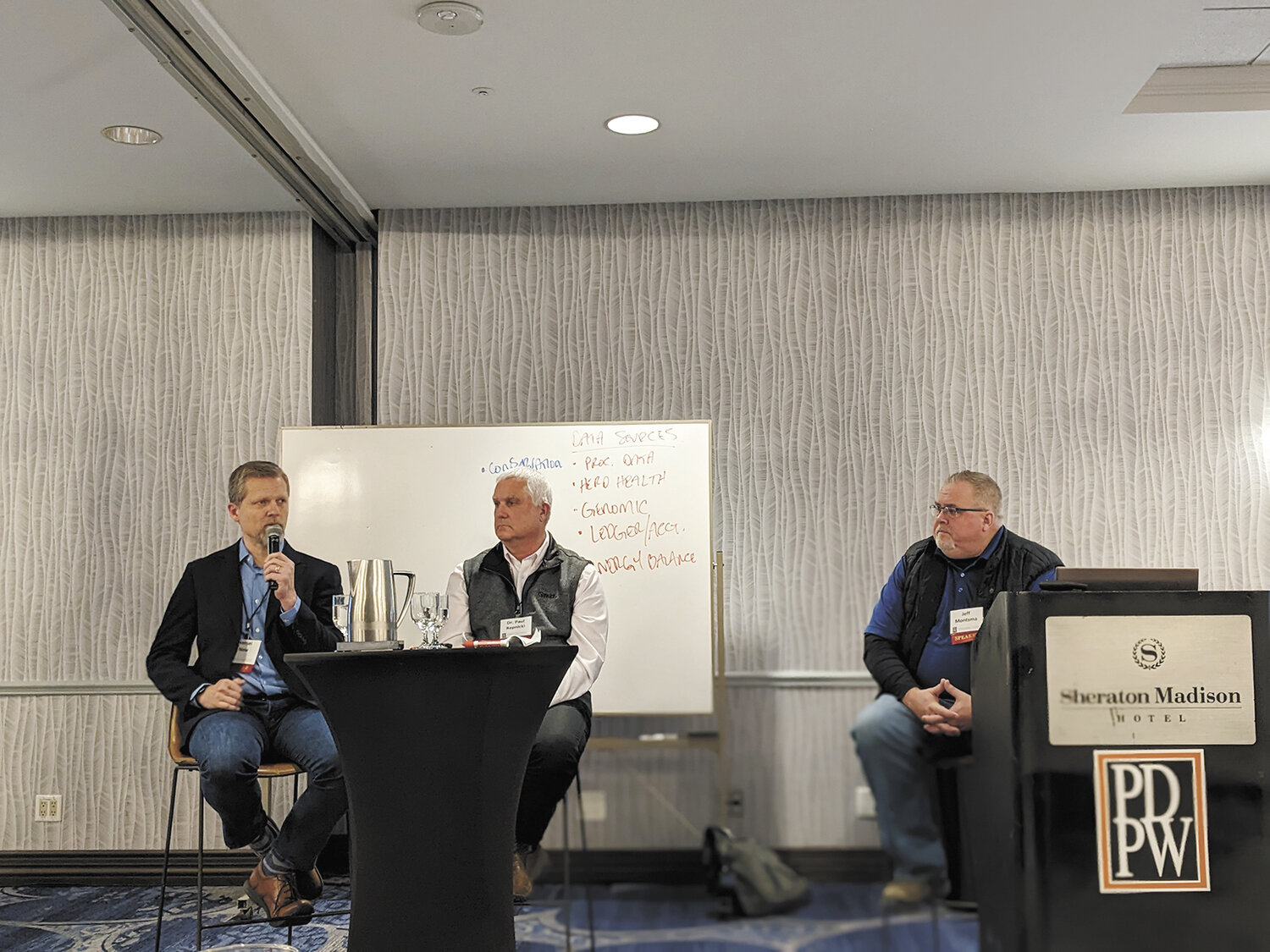
MADISON, Wis. — When it comes to carbon footprints, milk processors are putting the needs of their dairy farmers above the needs of their customers who sometimes demand a lot of data.
During a milk processor panel at Carbon Conference 3.0 hosted by Professional Dairy Producers Jan. 28 in Madison, four representatives from three processing plants shared thoughts on carbon markets. Those present included Jeff Montsma, U.S. operations milk procurement manager at Agropur; Hansel New, assistant vice president of sustainability strategy and programs at Dairy Farmers of America; and Dr. Paul Rapnicki, veterinarian and director of producer services at Grande Cheese Company. Jacqueline Stroud, sustainability project manager at Agropur, joined virtually.
“Our job as a farmer-owned cooperative is to represent farmers and ensure farmer data is protected,” Hansel said. “We want to ensure it is being used in a way that in the end is going to benefit farms.”
Hansel said a lot of evolution has taken place in carbon markets, sustainability and the quest for data in the seven years he has been with DFA.
“We’re doing business with all the large internal (consumer packaged goods) companies, and the data requests are not slowing,” he said. “Part of our job is to help determine the boundaries of what information the co-op is willing to share from the farms to do business and what information should be a value-add.”
Stroud said most, if not all, of Agropur’s carbon projects are driven by the customer.
“Four to five years ago, they started coming to us with requests that turned into demands,” she said. “To build a credible program in the carbon space, it comes down to data, and we need to take this at a collaborative level. It’s important for us to work with every single member of the value chain.”
One of the data pieces is a farm’s carbon intensity score, derived from a tool such as the Farmers Assuring Responsible Management Environmental Stewardship Program. This program gives a customized carbon footprint to farms. From this baseline, a farmer can learn how they compare to other farms in their area and the U.S.
When looking at carbon intensity of farms, all three processors tend to examine the aggregate data for a milkshed versus an individual score.
“We’re particularly concerned with the milk pool and how that number can be brought down over time through projects or incentive-based programs,” Hansel said. “Customers are all for that and want to support with cost-share opportunities. When it comes to individual farm data, that’s up to the farm.”
Grande has 65 producer dairies and has done FARM ES on over 90% of its milk.
“CI scoring is only part of what we need to understand about our milk supply,” Rapnicki said. “How our farms treat their employees and animals still matters. Fifteen years ago, the questions were mainly around animal welfare. Since carbon has taken off, our welfare questions have dropped to nearly zero. Assuring animal welfare is still critically important to our farms and for us in running our business.”
Stroud said there are opportunities in other markets for producers to gain incentives based on CI scores. Individual farms are asking what type of incentive they can receive if they make adjustments to lower their score.
“When you start implementing programs, you’re trying to bring down that number as much as possible so you go after the producers who might not be at the forefront of some of these initiatives,” Stroud said.
Some DFA customers are asking if they can get milk from farms with low CI scores.
“We certainly wouldn’t give away those low-carbon farms for free,” Hansel said. “How much is that worth to the customer? And more importantly, how much is it worth to the farmers who are already leaders in this space? It’s interesting to see where that goes down the road and if there will be customers willing to pay.”
Historically, and up to today, Stroud said incentives have been project-based at Agropur. If a producer wants to implement a new practice or activity, Agropur offers grants or supply chain funding to incentivize.
For example, Agropur has been using Nestlé and U.S. Department of Agriculture grants as a project-based incentive on the front end in its central milk region where product for Nestlé is sourced.
Stroud said they keep tabs on what the leaders are up to. Through a performance gap analysis, they see where the market is heading and determine action items.
“Customers are taking a step back and saying they don’t want to manage these projects anymore for the farms; they just want to see the results,” Stroud said. “They want to see a line item with the cost of the product they are buying and the carbon footprint of that product, but it’s not widespread in the market.”
For farms with generations of low CI scores, Stroud said it is their turn to get some of these dollars.
At DFA, incentives are outcome-based through existing carbon markets. The downstream customer agrees to take a certain number of credits for the year or for the next five years at a specified price.
“The last couple of years, we’ve seen a shift from upfront, incentive-based payments to outcome-based programs,” Hansel said.
Grande Cheese Company currently does not participate in any incentive-based programs.
“We have not seen any impact on our ability to do business based off the CI score,” Rapnicki said. “We’re not a consumer-facing brand. We go to restaurant operators, and they’re not asking us about CI scores. Five years down the road, the CI score of the milk might be more important.”
Rapnicki said in some areas however, reporting carbon might become a cost of doing business.
“We don’t make cheese in California, but we certainly want to sell into California,” he said. “In that case, we’re being regulated to do it for market access.”
Hansel said DFA continues to champion that farmers should be able to choose between an inset market where available. If unavailable, a farm should be able to enter an offset market without penalty.
“It’s their carbon and it’s their reductions that they should be able to monetize,” Hansel said. “It’s the carbon rules globally that need to evolve to be able to adequately recognize that.”
Hansel said carbon market rules were not written for agriculture and forestry.
“They were written for the emitters, not an industry like ag that can be both an emitter and a sequester,” he said. “The rules have to change.”
Rapnicki said producers can be the ones to drive discussion of changes in rules.
“There is no expert with all the answers, so we need to figure this out because no one can tell us exactly what the answer is,” he said. “We need our producers’ help to figure out where this needs to go.”
Hansel said demonstrating sustainability is necessary to maintain milk markets.
“We maintain that data has value, and we’re more than willing to give them the compliance data they need to maintain open milk markets and be a supplier of choice,” Hansel said. “There does come a point where we’re going to push back on the amount of data requested and use that as a negotiating point.”
Stroud said the processor is in a unique position.
“We’re going to be asked everything,” she said. “It’s our job to filter out what is actually required for this relationship and what’s a nice-to-have. Customers probably use 2% of the data.”
Rapnicki said quality is what moves products off shelves for processer and customer.
“We’re committed to supporting the U.S. dairy industry, which is the most efficient across the world at producing a pound of energy-corrected milk,” he said. “We’ve seen a lot of hot topics come and go. This is a hot topic, and it will be interesting to see where it goes next. What’s real is going to stick.”
 |
 |
 |
 |
Share with others


Comments
No comments on this item Please log in to comment by clicking here