
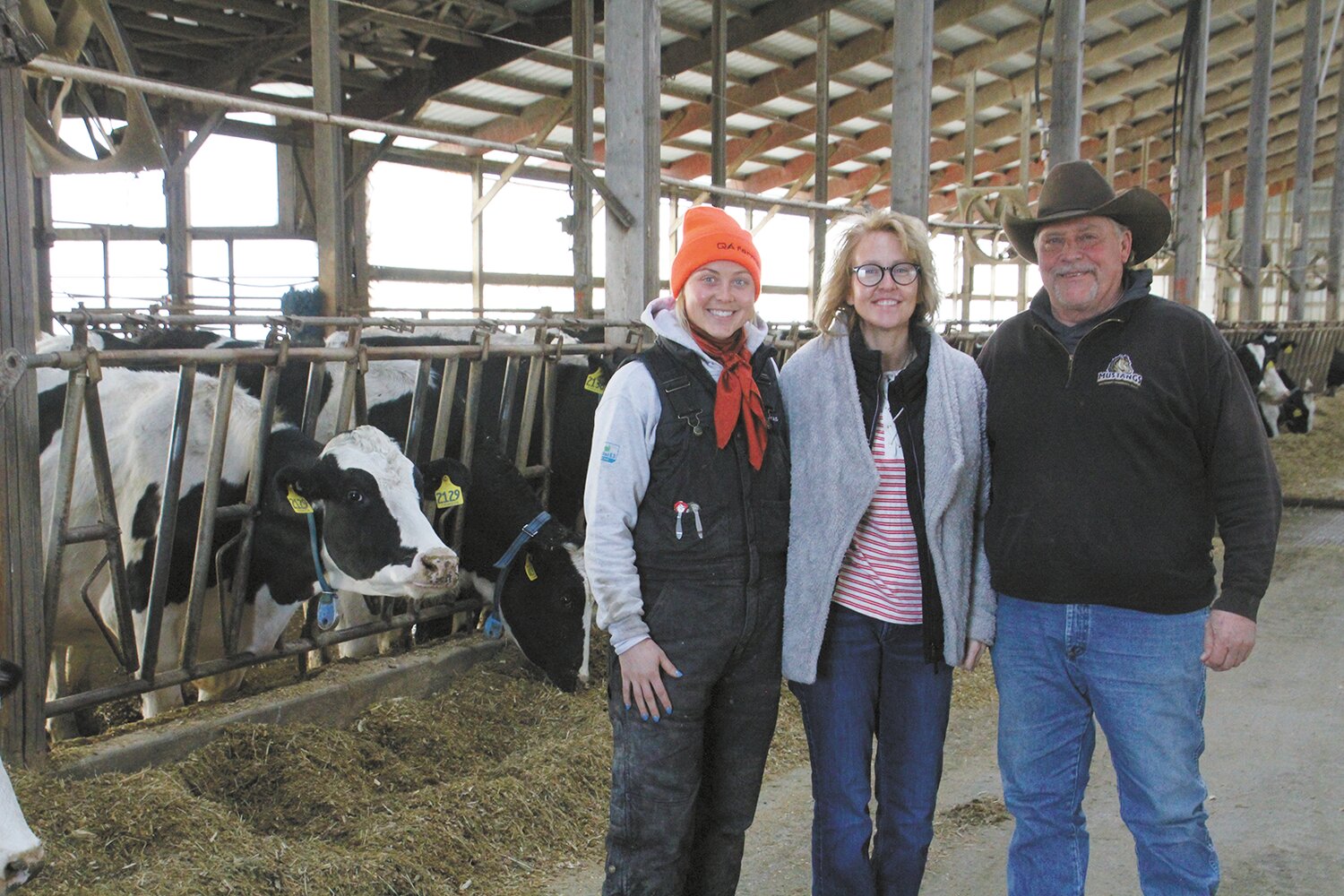
How many times a day do you milk, and what is your current herd average, butterfat and protein? We milk most of our cows three times a day, with later lactation cows milked twice a day. We currently have a rolling herd average of 30,000 pounds of milk, 1,330 pounds of butterfat and 976 pounds of protein.
Describe your housing and milking facility. We have a standard T-shaped dairy barn with four pens to separate lactation stages. We use sand for bedding. We milk in a double-6 parallel parlor.
Who is part of your farm team, and what are their roles? My youngest daughter, Sadie, and I work together to manage the farm, but it is a family team to get the chores done.
What is your herd health program? We perform pregnancy checks on the cows every Monday of every week. We use Bova Shield Gold FP5 L5 and Enviracor J-5 vaccines on the cows, splitting doses into intervals so it is easier on the cows.
What does your dry cow and transition program consist of? We dry off the cows 60 days prior to calving, with lactations of 305 days. Our goal is to calve on the cow’s birthday. We feed the dry cows a maintenance ration for 40 days, then at 21 days from calving, we move them from the dry lot to the pre-fresh pen and change the feed ration to a pre-fresh ration until they calve. We also use a Crytalyx lick barrel to enhance their minerals.
How long is your voluntary waiting period? We were at 70 days but backed it off to 77 days to maximize their milk production and ability.
What are your average days in milk? Our average days in milk right now is 145.
What percentage of your herd is in their first lactation? Thirty-one percent of our herd is in their first lactation.
What is the composition of your ration, and how has that changed in recent years? We started using forage sorghum for feed in 2014. It has increased the digestibility numbers along with our other forages. We also use corn silage, rye, haylage, long-stemmed hay and some straw in the dry cow diets for low potassium. It is the little things that make the difference in the pounds of milk and components.
Tell us about the forages you plant and detail your harvest strategies. We grow all our own feed. We have bought hay if we do not get enough from our own fields.
What is your average somatic cell count and how does that affect your production? We had 92,000 SCC at this last testing. If left unchecked, it would decrease our production. We do have spikes in the summer due to the heat and sprinkler system. We can offset it by making sure the sand bedding dries out during the hot months. We also watch for individual cows that would make the herd SCC increase by treating them or culling them.
What change has created the biggest improvement in your herd average? The quality of feed, the quality of sires we use, with a focus on butterfat and protein, and the viability of the sexed semen that we use. The decreased number of times we have to service the cows increases overall efficiency.
What technology do you use to monitor your herd? Dairy Comp 305 is the only management tool we use.
What is your breeding program, and what role do genetics play in your production level? Using our genomic history, our goal is to have 40% of the bred cows carrying Holstein females via sexed semen and the other 60% bred using beef semen. We know how many heifers we need every year to maintain replacement numbers.
List three management strategies that have helped you attain your production and component level. The quality of the sires we use, the feed quality, and the stewardship of the animals. We really focus and document a calf’s feeding and vaccinations to understand and know why a calf may be having health issues. Our record keeping helps to keep track of the animals throughout their productive years.
Tell us about your farm and your plans for the dairy in the new year. I would like to continue to do what we are doing while focusing on family time.
 |
 |
 |
 |
Share with others


Comments
No comments on this item Please log in to comment by clicking here