
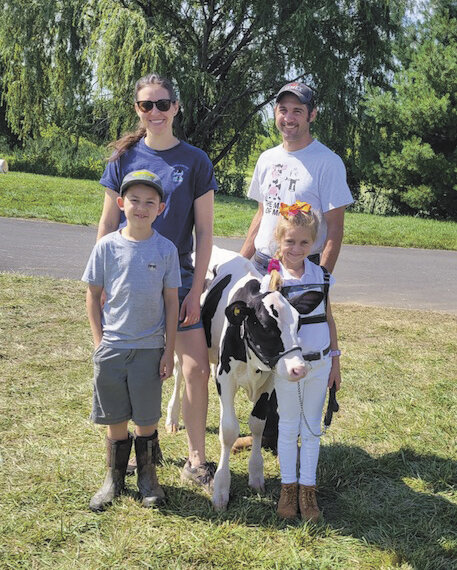


SOMERSET, N.J. — Operating the last dairy farm in Somerset County, New Jersey, requires navigation of suburbia. Middlebush Farm, owned by the Puskas family, is surrounded by housing developments.
“When we have trucks come to pick up corn, hay or soybeans, the drivers think they have the wrong address until they see the farm,” Matt Puskas said. “We have a lot of people around us. When you’re moving equipment, it can be dangerous. People don’t understand that equipment is big and slow and you can’t really see everywhere as well as you’d like to.”
In the 1970s, there were about 20 dairy farms and a small processing plant along their road, Puskas said, but the state bought 800 acres for a reservoir site through eminent domain, leading dairy farmers to eventually relocate their dairy operations or else close altogether. The plant closed too. Middlebush Farm was the only dairy farm to continue.
Puskas is the fourth generation on the farm. He and his wife, Erica, his father, Jim, and his uncle, Bob, milk about 70 cows. Cows are housed in a barn with a compost bed pack and have access to 15 acres of pasture at all times. The herd is milked in a 40-stall tiestall barn.
Milk is picked up by Dairy Farmers of America and goes to Tropical Foods about 45 minutes away where it is used for cheese and yogurt.
There is a lack of dairy infrastructure near Middlebush Farm. All parts, equipment and even tractors, Puskas said, come from Pennsylvania, usually from sites three or more hours away. The Puskas try to take advantage of sales programs and have several maintenance or repair jobs scheduled at a time during one appointment on the farm.
“You have to — otherwise, they are driving back and forth for several hours, and you’re paying for it,” Puskas said.
The Puskases raise their replacements. The herd is made up of registered cattle — about 30% Red & Whites, a few Jerseys and Brown Swiss, and the rest Holsteins.
“I like the Red & White Holsteins a little more,” Puskas said. “It’s neat to see cow families grow up and develop on our farm.”
Last year, one of the farm’s Red & Whites earned grand champion recognition at the state Holstein show. This year, her daughter earned the same honor.
Puskas met his wife when they were in college, both studying dairy science. Her parents and other relatives are registered Holstein breeders in Pennsylvania.
“I joke that I married her for her pedigree,” Puskas said.
Middlebush Farm sits on 24 acres the family owns, but they grow corn, soybeans, hay, grain sorghum and wheat across 1,100 acres. They rent land from the state and a handful of private owners.
“Soybeans do OK here, and for corn, we get about 100-125 bushels per acre,” Puskas said. “It’s not great ground, but it’s not total garbage ground either. The only thing we’ll buy for feed is any kind of protein — like soybean meal — and minerals, vitamin packs and stuff like that. About 95% of what we feed is grown on the farm.”
With their size of operation, the Puskases handle all tasks together, but they do receive help from people in exchange for allowing those helpers to hunt on the farm.
“We have a lot of deer — some spots have about 100 deer per square mile,” Puskas said. “There are a lot of safe havens for deer where we’re at, and then at night they’re in our crop fields eating our corn, soybeans and alfalfa. We have a shoot-to-kill permit, and we’ve been shooting on average about 100-120 deer a year.”
The Puskases donate most of the meat to a charitable organization. The family also farms ground owned by Rutgers University. Deer harvested from that ground is donated to foodbanks on the university’s behalf.
Although suburbia causes challenges at Middlebush Farm, Puskas said, it also brings benefits. Having more people in their area means there are more customers for diversification.
“In the spring, we have a lot of people who buy manure from us for their gardens,” Puskas said. “We also sell deer corn. We’re allowed to bait deer for hunting in New Jersey, so we sell 50-pound bags of deer corn to hunters in the area.”
They also sell round bales of hay and straw, mostly to horse farmers.
Having a customer base might be key to future goals of Middlebrush Farm.
“We’d like to bottle and sell our own milk,” Puskas said. “As far as us being profitable as a dairy farm, we definitely need to do that or have a little on-farm market or get tied into food banks or other local restaurants — things like that where we can market our product a little more local.”
In the meantime, the family is reaching out to promote dairy in their county. This past summer they hosted the Somerset County’s annual Ag in Action event that rotates to farms, inviting the public to learn about agriculture.
“I like to educate the public because they’re our consumer, and they are the ones who are going to vote on a lot of stuff that comes down, so they need to know more of the story than what they just see on YouTube or Google,” Puskas said.
Middlebush Farm also partnered with the county’s Farm Bureau to create a series of Ag in the Classroom videos.
“It was really fun,” Puskas said. “Education is one spot in agriculture that everyone needs to do a little better on. We need to have a stronger voice because we are only a small percentage of the population.”
Puskas said he envisions his young children, Joel and Allison, possibly choosing dairy farming, bringing the farm into the fifth generation. Both children are in 4-H and dairy club. Allison showed a calf at the state Holstein show last year.
“It’s neat to see our kids’ interests and passions develop,” Puskas said.
As his family decides next steps for the farm, Puskas remains positive.
“It’s good to see where we were at one point and where we are now and then look to the future to see what you can change or update and see what ideas you have,” Puskas said. “I like the creativity and the openness because there’s not one right way of doing things, right? You come up with an idea and try it, and if it doesn’t work, you come up with a different idea and try again. That’s what farming is.”
 |
 |
 |
 |
Share with others


Comments
No comments on this item Please log in to comment by clicking here