
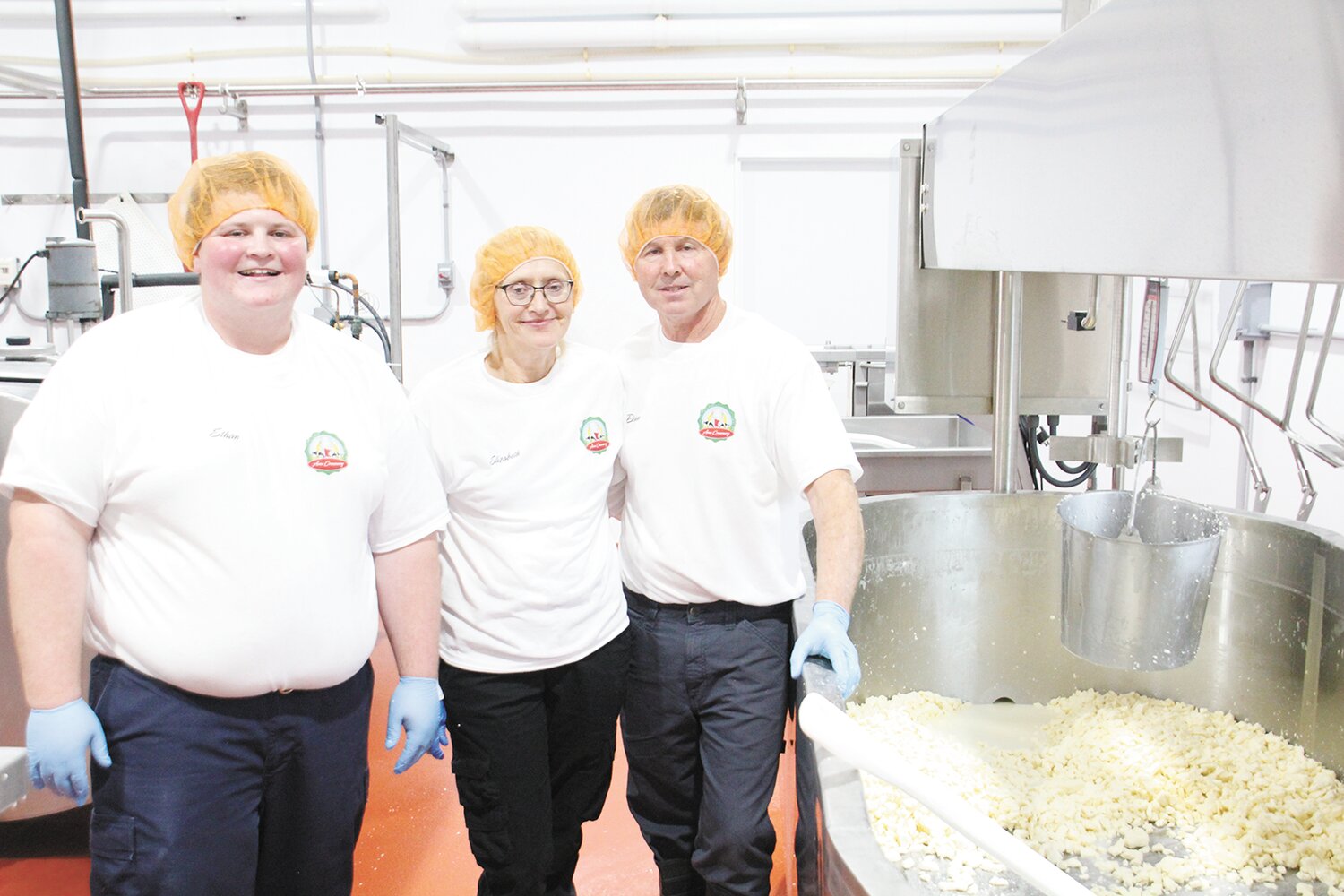


HERON LAKE, Minn. — A lack of nearby processing facilities and an interest in the benefits of A2A2 milk has launched Ethan Johnson and his family on the pathway to starting their own creamery.
“The whole goal is to try to make a product that more people can enjoy and is nutrient dense and made here, locally, fresh,” Johnson said.
The creamery will process the Johnson’s high intensity grazed; grass-fed, A2A2 milk. Johnson and his parents, Dean and Elizabeth, milk 25 crossbred cows and grow row and cover crops on their dairy near Heron Lake.
The family plans to open Amo Creamery officially Nov. 20. Non-homogenized whole milk, cheese curds and cheddar cheese will be made and sold at the creamery as well as a few other products from Minnesota farmers. Fresh cheese curds will be available on cheese-making day.
To process, their dairy’s milk will be brought from the barn to the creamery in a small bulk tank. After being pasteurized, the milk will be bottled in 12-ounce and half-gallon bisphenol A-free plastic bottles.
When choosing a name for their creamery, the Johnsons leaned into history.
“The original Amo Creamery was named after our township and opened over 125 years ago,” Johnson said.
The original Amo Creamery was owned by 50 dairy farmers. The butter was shipped to New York to sell on the butter exchange. When the train tracks moved north to Storden, the Amo Creamery moved as well. The creamery later closed in the 1970s.
The factors influencing the Johnson family to consider starting their own Amo Creamery 55 years later, began while Johnson was still in high school. At the time, the family farm was doing well, but more and more area dairy farmers were retiring or shifting their farming away from dairy. With their farm being over 100 miles away from the closest processing facility, their family depended on other farms to help fill the milk truck to justify the travel.
After high school, Johnson was not sure if dairy production would still be possible on their farm in the future. He attended South Dakota State University in Brookings, South Dakota, and majored in dairy manufacturing.
While at SDSU, he worked at two milk processing plants during the summers to gain experience to bring back to the family farm. During the 2020 spring break, Johnson and a classmate toured 14 on-farm processors who bottled their own milk and made cheese.
“It was fascinating to me,” Johnson said.
After graduation, Johnson worked for Ecolab. There he worked with processing plants and gained a helpful understanding of cleaning methods and protocols to take back to the farm.
Ethan returned to the dairy farm with knowledge and a plan to open Amo Creamery.
On the farm side, the backdrop of Johnson’s plan included two key farm management areas: the genetics of their herd and their feeding program.
The genetics aspect of the plan began in 2013, when Johnson, a fifth-generation dairy farmer, purchased his first registered Holstein heifer for his 4-H project.
Johnson gained an interest in dairy genetics while looking for a service sire for his heifer. When considering genetics, he came across A2A2.
“At the time, New Zealand was marketing A2A2 milk due to sensitivity (among consumers) in Southeast Asia,” Johnson said. “Consumers were willing to pay three times more since it is a more digestible product.”
Johnson decided to breed his heifer to an A2 bull since the cost was comparable to an A1 bull. Since then, the Johnsons have bred exclusively to A2 bulls to be open to new possibilities to market their milk.
On the feeding side of their operation, Johnson wants to utilize high density grazing to increase the nutritive value of their milk. Johnson learned from an SDSU study about milk being a good carrier of omega-6 and omega-3. While attending a soil health academy in 2021, Johnson learned that high density grazing will cause milk and beef to have a better ratio of omega-3 to omega-6. Bettering their omega-3 and omega-6 ratio is a goal of Amo Creamery.
The Johnsons are currently using high-density grazing. Their six pastures can be broken down into 50 to 70 paddocks, depending on the amount of grass available. Johnson said their goal is to graze off 100,000 pounds per acre before moving the cows to the next pasture and to not return for 40-60 days to allow for regrowth.
This grazing procedure helps increase the plant diversity and the nutritional value of the plant as well Johnson said.
“You are what you eat,” he said. “When cows eat healthier forages, they are creating a more nutrient-dense product.”
Currently, the family is milking twice a day, but Johnson said their long-term goal is to turn to a grazing format where they only milk once a day.
“Production will decrease, but the components in the milk will be about 20% higher,” Johnson said.
A nutrient-dense product will increase milk processing efficiency. However, with most of the herd still Holsteins, it is not appropriate for the herd yet.
The Johnsons plan to change the breed makeup of their herd. When Johnson had visited farms that processed their own milk five years ago, he had noticed a few of the farms had tri-cross animals. These Fleckvieh, Holstein and Jersey cross animals were targeted because of their smaller size and feed efficiency while still producing well. Eventually, the Johnsons plan to do the same and transition to tri-cross in their herd.
As they look forward to opening their creamery in a few weeks, the Johnsons said they are so grateful for all the community support. To help recognize those who have been part of their journey, Johnson is making social media posts on the Amo Creamery Facebook page to recognize their suppliers and vendors for their support throughout the project.
 |
 |
 |
 |
Share with others


Comments
No comments on this item Please log in to comment by clicking here