


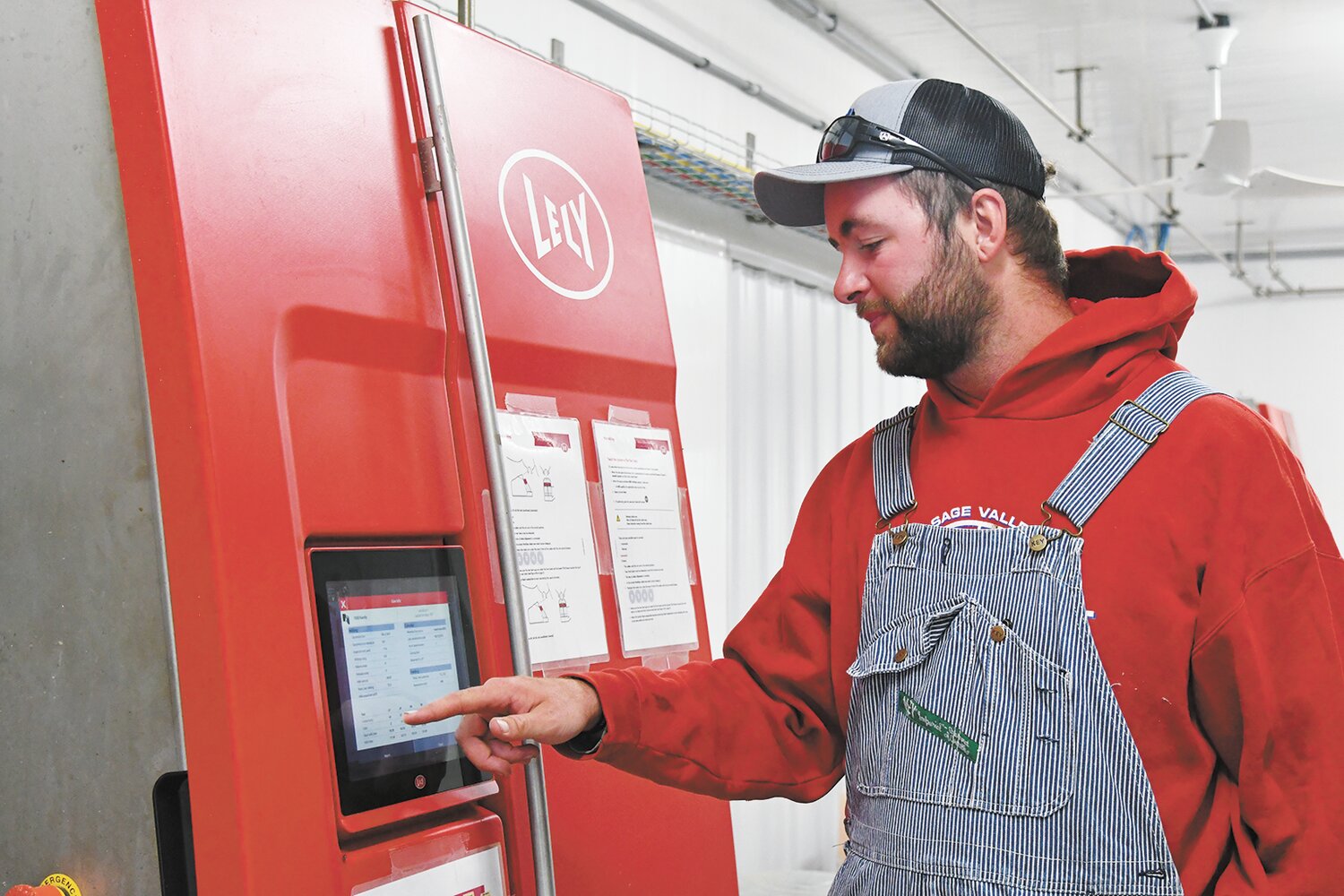


STEWARTVILLE, Minn. — Andrew Gathje has wanted a robotic milking setup for 10 years, ever since he wrote a 10-page research paper on the subject for his English class his senior year of high school.
The Gathje family — Andrew, his dad, Andy, and his brother, Ben — had their robotic dream come true Feb. 18 when they moved into their brand-new 136-stall freestall barn and started milking their herd with two Lely A5 robotic milking units.
“(I was) always hoping that even if I never did get the robots, I’d at least be able to have a parlor someday,” Andrew said. “The robots ended up being what we did in the end, and it was definitely the right choice for us and our goals for our operation.”
Today, the Gathjes are milking 105 Holsteins, with a few Red & White Holsteins thrown in. Before the move to their new setup, they were milking 55 cows in a 46-stall stanchion barn.
“Not much had been done to it since the 1950s, when that had last been remodeled,” Andrew said. “The barn as a whole was getting really tired, and in terms of cow comfort and the mental sanity of not only the cattle but us,
we knew it was time to do something or get out. And I did not see myself happy getting out and trying to do something else.”
After touring around 18 parlors and robotic milking setups, the Gathje’s decided to go with robots over a double-12 parlor. Several factors swayed their decision.
First, because they needed a new barn regardless of whether they installed a parlor or robotic milking units, the cost was not as far apart.
Second, the cost of the barn itself ended up being lower than expected, Ben said.
“Since the whole barn ended up being flat, the building was less money, so we were able to spend more on milking equipment,” he said.
Third, the family considered making time away from the farm, especially as Andrew and Ben and their wives hope to eventually have families.
“Even though the break-even cost of production with the parlor would have been about $1 per hundredweight lower, we decided that with wanting somewhat of a life off the farm and being able to cover each other for vacations or future kids’ ball games or whatever it is, that the robots would be the better option,” Andrew said.
The lower cost of the new barn also allowed them to put in an area for dry cows. The new barn is across the gravel road from the old stanchion barn, so this means they do not have to transport 300 feet across the road.
“We didn’t really want to do that, and we knew that having the extra cows out here that we would need the extra space for calves and heifers,” Andrew said.
Dirt work for the new project started in August 2024 and the startup day was 21 degrees below zero temperatures in February.
“It was good to go through what to look for when it gets that cold, to make sure the robots keep working and all your water lines stay on,” Andrew said. “Otherwise, we’d have to figure that out on our own cold turkey. Thankfully, there weren’t too many surprises.”
The Gathjes had begun buying heifers in September 2024 to increase their numbers. When they switched over to the new setup, they were milking about 90 and had been switching several times in the stanchion barn to get them milked.
At startup, around 65% of their herd was first-lactation heifers. Ben said he recommends farmers have a high percentage of young heifers at startup.
“They train really well and they’ll end up lasting longer,” he said.
The Gathjes had a larger number of older cows that did not transition well and had to be sold. The Gathjes said this was in large part because the cows had never seen free stalls before and did not get used to their new housing.
“We should have probably just shipped those oldest 12 cows and used that money to buy some heifers that would have adjusted in here easier,” Andrew said. “We just didn’t know any better, and since cows are expensive, we wanted to see how they did.”
The robotic milking units themselves went over well.
“Coming from the stanchion barn … even though the arm was coming in from the side, the cows were all used to that,” Andrew said.
The Gathjes have a free-flow system and feed their cows on average about 9 pounds of grain at the robotic milking units, depending on production. Generally, they give about a pound of grain per 10 pounds of milk. They use a mixture of cracked corn and distillers grain instead of robot pellets. They said this was almost 50% cheaper than using a pellet.
“We started with that right away so that way they wouldn’t know any different,” Ben said.
Initially on startup, the Gathjes said they saw their somatic cell count increase. But since then, it has improved. The cows are bedded with waterbeds with sawdust on top. In June, they also started putting Unical down to help dry the stalls. Andrew said their somatic cell count halved in about three weeks with the drying product.
“Our average cell count for the month of August was 122,000,” Andrew said. “Whereas across the road, if we were below 400,000 (in the summer), we were ecstatic.”
One thing the Gathjes would like to add to their setup is a dedicated storage space for sawdust.
Looking to the future, the Gathje family’s setup has room for growth. The barn has space for a third robot. The electrical, plumbing and bulk tanks are all sized for three robotic milking units. The barn itself is large enough to support three robots’ worth of cows and the only add-on would be a second manure collector and the robot itself.
 |
 |
 |
 |
Share with others


Comments
No comments on this item Please log in to comment by clicking here