
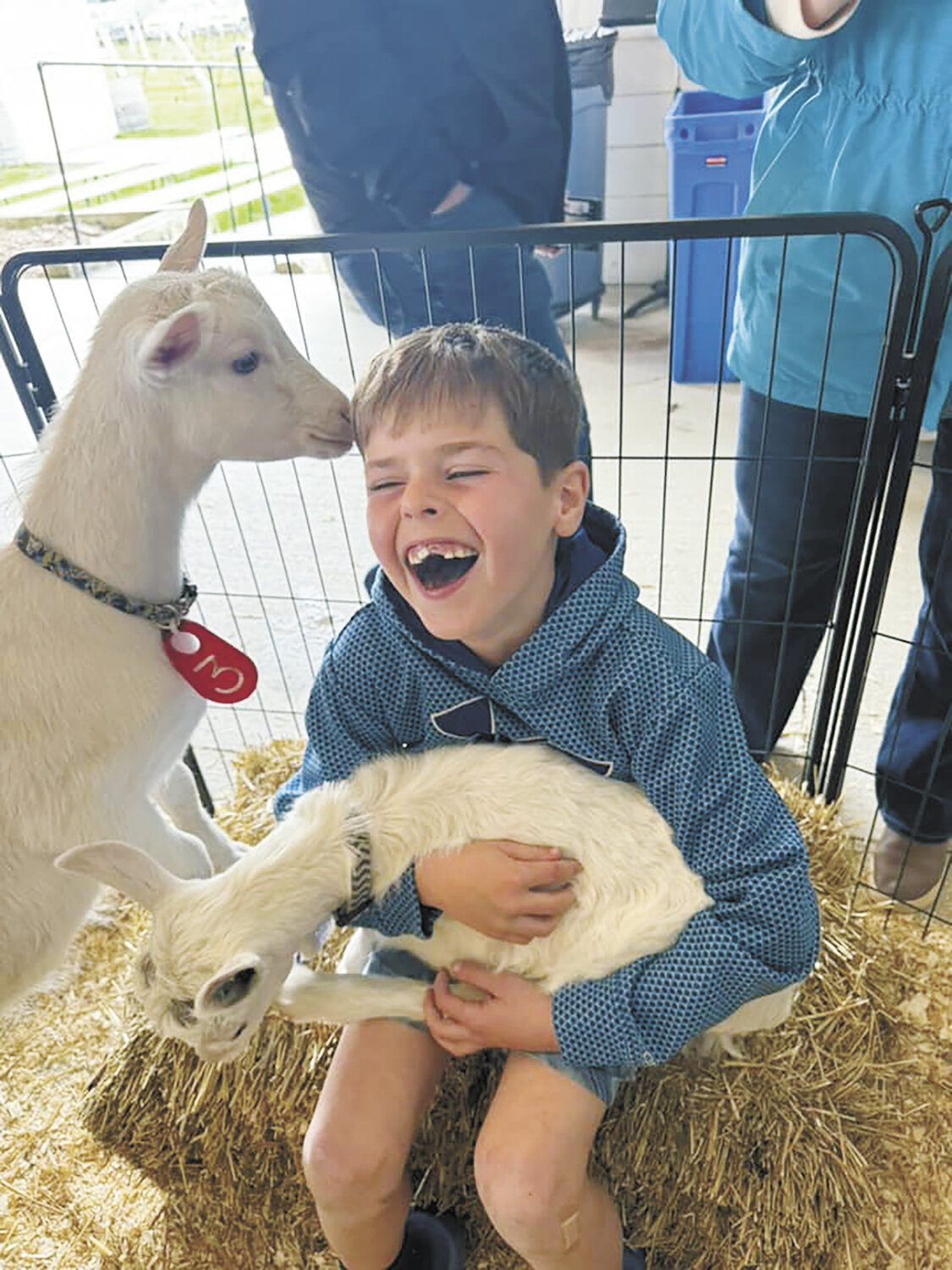


NEW PRAGUE, Minn. — A good mood filled the air April 27 as kids and adults alike waited their turn to play with Saanen goat kids at Next Chapter Winery near New Prague.
The goats were from Four Seasons Farm near Jordan, which is owned by Chris and Laura Kieser. The Kiesers brought all 14 doe kids born this spring. Eight kids at a time hung out with attendees while the others were rotated into the group, giving each kid a rest time when they needed it.
“Goats are so personable, people can’t help but smile,” Laura Kieser said.
Jackie Brockway, one of the owners at Next Chapter Winery, agreed.
“The baby goats were such a hit,” she said. “They were so adorable. It was amazing to see children and the goat kids interacting.”
The winery estimated over 1,000 attendees came from noon to 5 p.m. Kieser said the line to see the goats was about 20 minutes long at times.
“Every once in a while, I would walk up and down the line … and I would thank them for coming,” Kieser said. “They were just so happy to be there. They were so excited. Not one person was upset or anything (about the wait). It was so amazing.”
Attendees could also visit vendors with goat soaps and lotion, cheese, maple syrup, bread, crafts, caramels, books and more. They could also partake in meals from three food trucks.
The Kiesers’ friends from the goat community helped them with the flow and logistics of the day.
Brockway said all age levels of attendees were interacting with the goats and learning.
“(They were) being made aware that these animals are part of our lives, without us even knowing about it,” Brockway said. “Farms in general are just such a big part of how we eat, how we live.”
Kieser takes a gentle approach to agriculture promotion.
“You can’t push a person to think beyond where they are in that day or moment,” Kieser said. “All you can do is provide the answers for the questions they’re asking.”
Kieser said it takes a lot of storytelling to show attendees how the goats affect their lives.
“We have these cute little animals that people relate to,” Kieser said. “If they’re really interested in their food source, then they continue to ask those questions, and we continue to provide those answers.”
However, she said some people are not ready for that.
“They find a little bump in the story that they’re a little uncomfortable coming to terms with,” Kiesser said. “Sometimes reality is not necessarily what they think it is in a storybook.”
Kieser said they monitored the kids closely to give them a break when necessary. They noticed the kids were tired, though, for the next day and a half. She said normally, when they feed during chore time, the goats are bouncing off the wall. They did not do that for a couple of feedings, but she said they are back to their normal antics now.
The idea for the event, which first happened last year, came by accident. The Kiesers had been going to the winery for several years and became friends with the owners. Last winter the Kiesers joined a book club put on by the winery. When kidding season came around, one of the book club meetings coincided with the feeding time for several goat kids. Instead of missing the book club, they brought the kids in a plastic tote and fed them there.
“We attracted a little bit of a crowd as you might imagine,” Kieser said.
After the book club was done, they stayed to let other guests at the winery interact with the goats.
After that experience, the Brockways reached out, wondering whether the Kiesers would be willing to do an official event.
The first year’s event in 2024 drew a crowd of 400-500.
“None of us estimated how popular it was going to be,” Kieser said.
When it comes to next year, Kieser said if the Brockways want to do it again, and they can find a time that works, they will certainly entertain the idea.
They have decided that one of these events per year is enough, however. Their kids are only young for a certain amount of time. Plus all the interaction puts stress on their herd’s most vulnerable population.
The Kiesers’ main focus on their farm is developing quality genetics to sell. The Kiesers breed for longevity, production, structure and a rugged/sturdy frame.
Kieser grew up with goats, but they were sold when she was in college.
“When (Chris and I) were planning our lives together, I said, ‘Well, not sure where we’ll end up, but I want land, because I would like to have goats again,’” Kieser said.
They started their herd in 2004 with Saanens and Nubians. In 2014, they sold the Nubians and concentrated their efforts on the Saanens.
The Kiesers both work full time off the farm and do not have outside help. They try to keep a herd of about a dozen does.
“It’s a continual challenge on a small herd scale, because you want to see those genetics come to fruition, but that takes three or four years,” Kieser said. “Sometimes you just don’t have the space to do that for as many as you’d like.”
Their herd is shown regionally and nationally, appraised with the linear system and tested through the Dairy Herd Improvement Association, which has been done for about 15 years.
Though sales of genetics are the focus of Four Seasons Farm, not goat events, Kieser said watching the interactions between attendees and the goats at the winery event encouraged her.
“They are a reminder, in some ways, of why we do this: to see the smiles on people’s faces, to see those kids’ faces who are just lit up by the interaction,” Kieser said.
 |
 |
 |
 |
Share with others


Comments
No comments on this item Please log in to comment by clicking here