
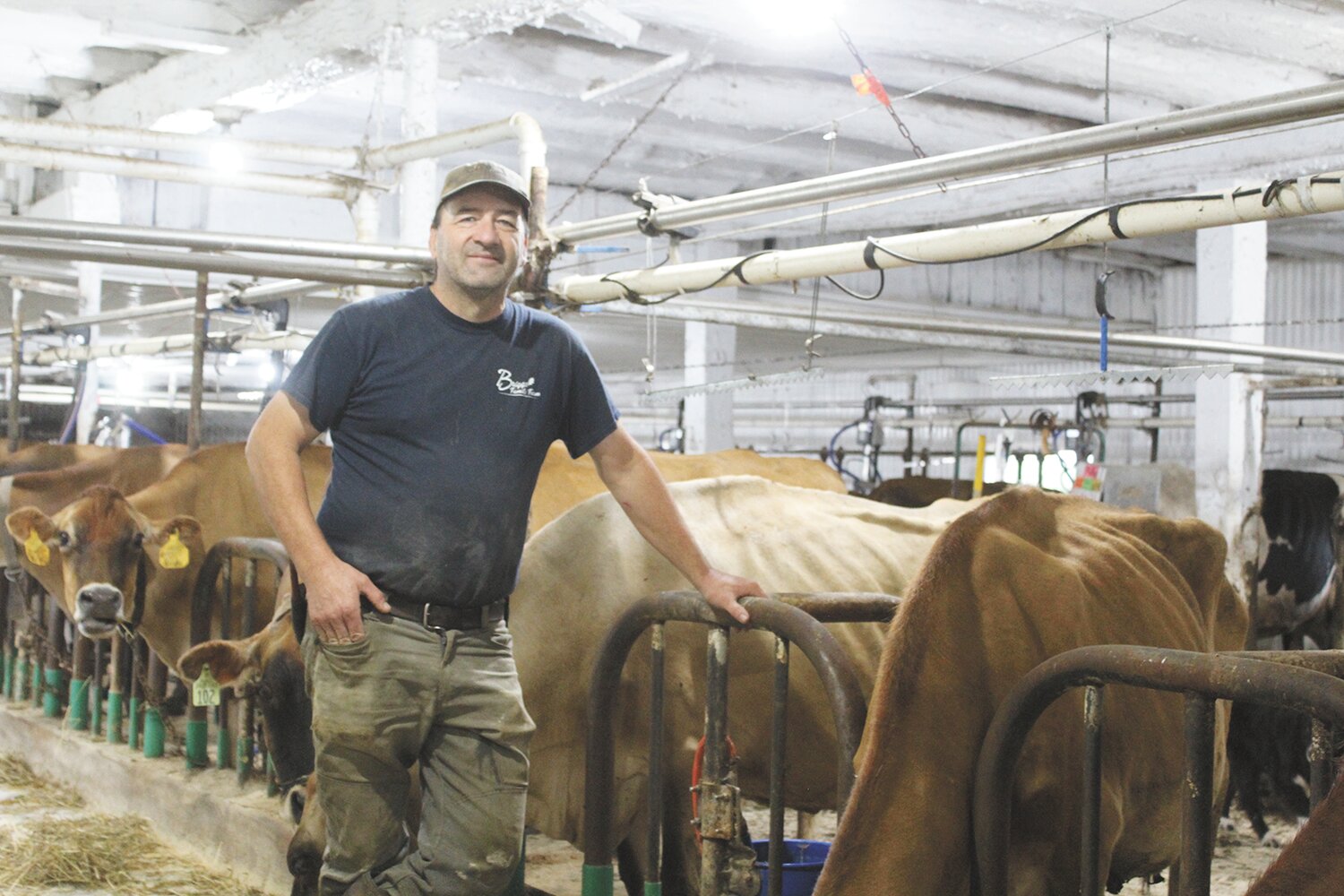
Describe your farm and facilities. We milk about 95 cows between two different farms, both in tiestall barns. We practice rotational grazing.
What forages do you harvest? We are mostly clover-based. We mix a little bit of alfalfa in, but no straight alfalfa. We have been doing a lot of Timothy-clover mixes the last few years because it really seems to do well with the wet weather we have been having, and this country is really made for it. We make all our hay as baleage; we do not chop any haylage. We raise 60 acres of corn that we make all as corn silage.
How many acres of crops do you raise? We’ve got 240 total; about 160 of those we crop. We’re losing another 20 this year because we are putting in more fencing for grazing at the second farm.
Describe the rations for your livestock. We keep our rations pretty simple. On one farm we feed a total mixed ration with corn silage and protein mixed together. In the summer, they are out grazing. In the winter, we feed baleage in the barn. The second farm is about the same, with protein and corn silage but no TMR, pasture and baleage.
What quality and quantity do you harvest of each crop? The last two years, with the way the weather has been, we do whatever we can get. We aim to cut every 30 days, but the weather has made that difficult at times. We have had two wet years and a drought the year before that. We are doing a little bit better this year than last year, but it has been far from ideal, weather-wise.
Describe your harvesting techniques for alfalfa and corn silage. We chop all our corn silage. We make all our hay as baleage in round bales that we wrap either individually or in line. I have found baleage is easier because I am pretty much a 1-man operation for harvesting.
What techniques do you use to store, manage and feed your forages? We store all our corn silage in upright silos. We have our own individual wrapper for wrapping baleage. Sometimes we hire someone to line wrap the first crop. I have a bale unroller to feed it and that works well.
How do quality forages play in the production goals for your herd? Forage quality is something we are always trying to improve on. It has been a struggle for the last couple of years. We just try to manage it the best we can with the weather and adjust the protein as needed, depending on what we do get for quality.
What management or harvesting techniques have changed that have made a notable difference in forage quality? Moving from haylage to baleage has made a big difference. I am pretty much a 1man show when it comes to cropping. I have a retired neighbor who helps out some when it comes to cropping, but that is it. I can bale a lot of hay in an afternoon and have it wrapped within 12 hours, whereas if it were haylage sitting out there waiting to chop, it would be powder dry by the time it got chopped — and I would need someone to be shuttling wagons and unloading. With the baleage we end up with almost zero waste.
Describe a challenge you overcame in reaching your forage quality goals. The biggest challenge is the one I cannot control: the weather. That and limited labor are the biggest challenges.
 |
 |
 |
 |
Share with others


Comments
No comments on this item Please log in to comment by clicking here