


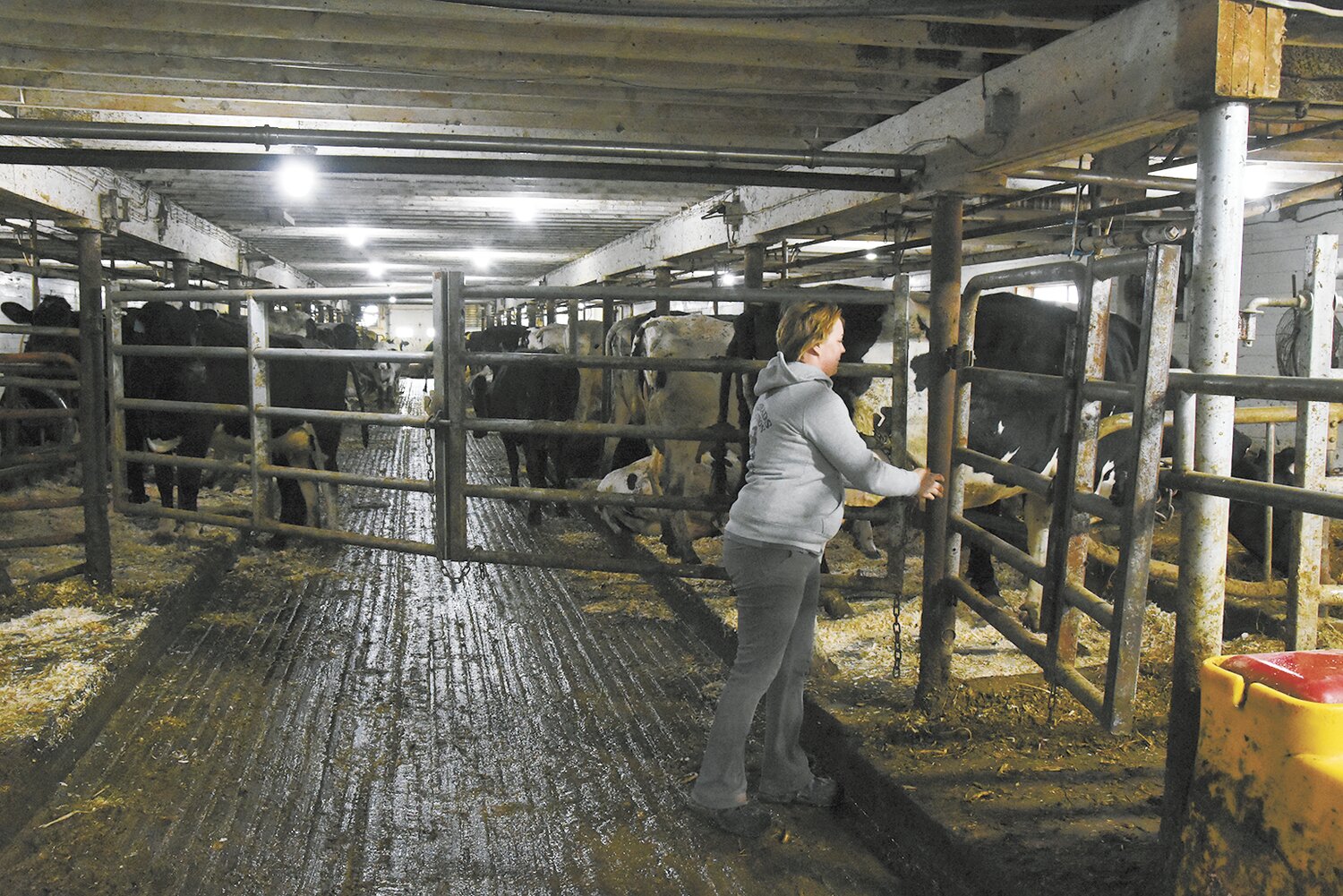


ALBANY, Minn. — From the outside, the barn owned by Jason and Lynn Gerads looks like a typical tiestall barn. But inside, it includes something different: a new milking robot situated among the stalls.
“Everything is easier now,” Jason said. “Before, I figured between the two of us, it was nine hours of chores for milking, feeding and hauling manure each day. Now, it takes about two hours.”
His wife, Lynn, agreed.
“For me the biggest thing is getting in earlier to have more time with the kids,” she said. “I felt like I was in the barn all the time and whenever I was in the house, I would be thinking of things that needed to get done out here; it was hard. Now, I have more time for other things, chasing the kids to their school activities, helping (Jason) if needed and other mom duties.”
The couple have three children: Samantha, Camille and Taylor. Besides for dairying, they also have a broiler barn.
Over a year ago, the couple had made the decision to put in a manure pit on their dairy farm. The more they thought about it, the more they looked at the setup of their 72-cow dairy near Albany.
“We thought if we are (putting in a manure pit), then we are going to keep milking for another 20 years,” Jason said. “I already had one knee replaced and thought, ‘Do I really want to milk in a tiestall barn for another 20 years?’”
To put in the manure pit, the north side of the barn had to be remodeled for piping.
“We thought this would be the time to do something because we had to rip out the cement anyway,” Lynn said.
The couple weighed their options and came up with the idea to retrofit their tiestall barn to a freestall barn and build a room for a milking robot.
“Our barn is still in good shape,” Jason said. “To build anything new you would need to double to triple your herd to pay for it all. I wouldn’t have done it if I had to build new.”
The Gerads visited Leedstone Inc. in Melrose, where they shared their vision for putting a robot in their tiestall barn.
“We basically said, ‘We want a robot on this end of the barn,’ and they knew the amount of space everything would need, and they made it work,” Lynn said. “They knew what they were doing.”
That was June 2024, and by January 2025, construction started for the new addition. By March, the robot was being installed.
“All we did to the tiestall barn was drop the alley down 6 inches and made it flat all the way across,” Jason said. “We left the stalls as is for the cows.”
A 16-foot addition was added onto the north end of the barn for the robot room and an office. One Lely A5 Astronaut milking robot and one Lely Discovery manure scraper were in-stalled.
“I was looking at the time and money I would save by having more time for other things around the farm because now I don’t have to hire out as much help for all the other things,” Ja-son said.
Jason said they only had to cull a couple cows due to teat placement and size, but over-all, they had to cut back on their cow numbers to bring them under the robot’s 70-cow capacity.
“They adjusted surprisingly well,” Jason said. “We got some extra help lined up to help with the first two weeks, but after five days we were able to take care of everything by our-selves.”
One factor Jason and Lynn attribute to their smooth transition was switching the cows over slowly in small groups.
“We started with 40 cows, then once they were adjusted, we would add about two cows a day and milk everyone else in the back of the barn in the stalls yet,” Jason said. “It took about three weeks to transition them over.”
Since adding the robot, the family has noticed milk components have increased. Somatic cell count went up for several months but has now dropped to pre-robot levels.
Another highlight from installing the robots for the Gerads family was that the collars help detect heat, said Lynn, the farm’s A.I. technician.
“That was super helpful; it’s incredible how accurate they are,” she said. “There was some that we missed before, with just not seeing it, or if they just had a low-grade heat.”
Jason agreed.
“That is the second-best part of it all,” he said. “It shows us not only when they are in heat but when the best time to breed them is. We are catching a lot more heats.”
The Gerads family changed how they milk their cows, but many other aspects stayed the same. They feed with a feed cart, bed their mats with shavings and put their cows on a dry lot every day for an hour. That remains possible by maneuvering a couple gates that allow the cows to come and go from the pasture to robots.
“One of the benefits is we feel like we are not rushed anymore and 10 steps behind,” Jason said.
Overall, the transition went even smoother than the Gerads family expected.
“I don’t think we could have gone more than 10 years with our previous set-up,” Lynn said. “I thought I would miss milking the cows, because I liked being with the cows, but I don’t miss it all because I am still out in the barn every day.”
 |
 |
 |
 |
Share with others


Comments
No comments on this item Please log in to comment by clicking here