
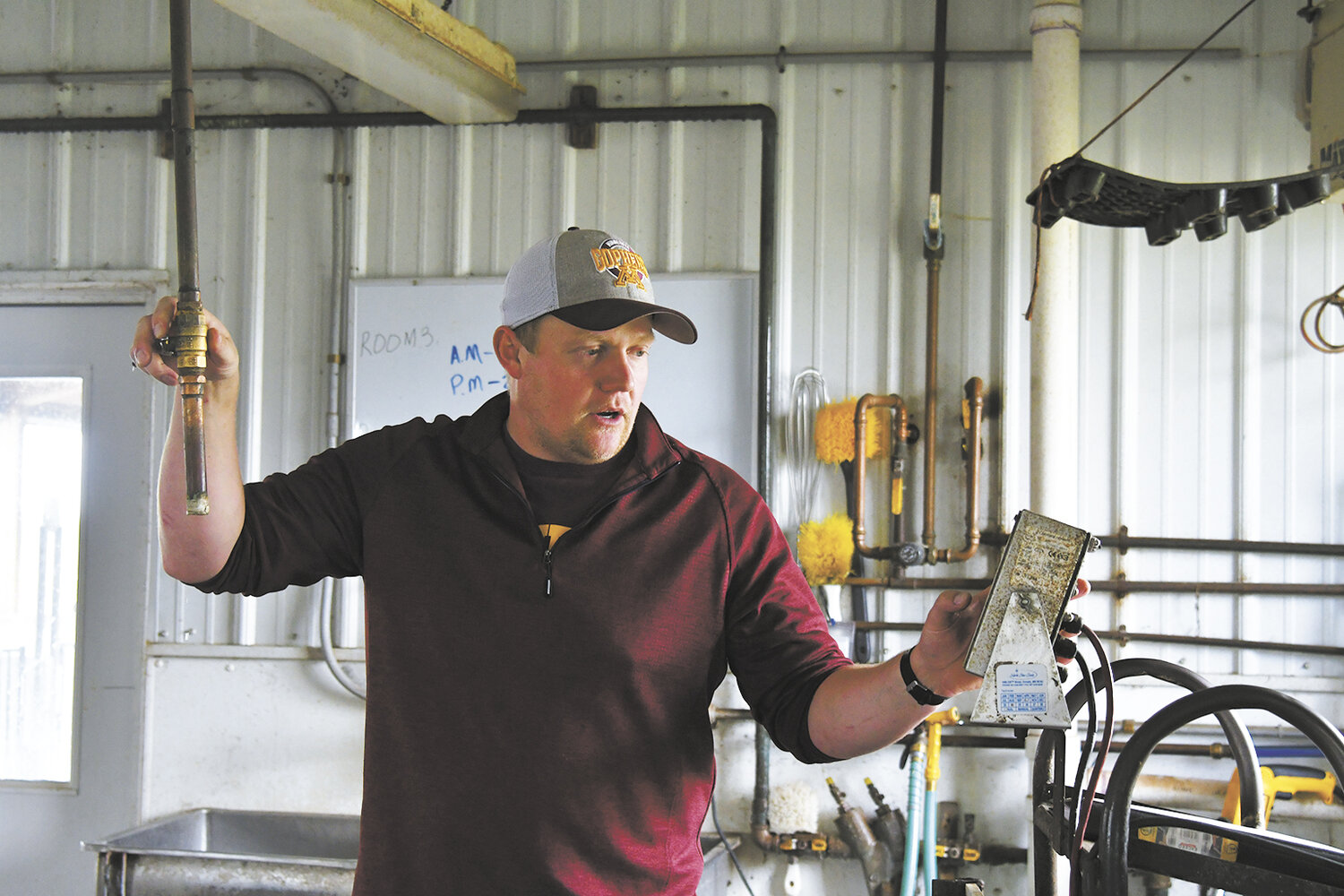


WASECA, Minn. — Andrew Plumski oversees the raising of 950-1,000 calves a year from newborns until 6 months of age. The calves, which come from three dairy operations in the area, are part of research Plumski is conducting on nutrition and management.
Plumski is the dairy calf unit manager at the University of Minnesota’s Southern Research and Outreach Center near Waseca where he brings six years of on-farm calf and herd management experience to the research he helps conduct.
“I really enjoy working here and seeing the research we’re doing,” Plumski said. “Going back to when I was on the dairy, this is the type of research data on products and things I would (have) wanted to see.”
Plumski works alongside three full-time and two part-time employees. U of M faculty member Dr. Isaac Salfer helps with trial design, data analysis and official reports. The U of M does not own the calves and Plumski must ensure his research does not negatively impact the young animals. When research studies conclude, he must provide healthy calves capable of becoming productive, profitable cows back to the dairies they came from.
Each research project contains 100-120 calves. The calves are evenly distributed from each dairy to control the variables. Studies generally last 3-4 months.
Plumski said one of the biggest challenges facing calf raisers is cost.
“It’s very expensive to raise a calf, and that gets into some of the research we’re doing here,” Plumski said.
An example of this was a research project on how to feed calves dried cheese ingredient that was not used for human consumption. This dried cheese ingredient presents an affordable, easily digested protein option that reduces waste.
Plumski is interested in doing more studies where long-term performance data from first lactation or beyond is studied as well.
His calves at the Southern Research and Outreach Center are picked up at 2-5 days of age. Each calf has its weight and hip height measured on the day it enters the facility, at 56 days and when it leaves the facility. At 4 months, its weight is also measured.
Waseca features group housing with automatic calf feeders, group housing with a milk bar and individual housing. The group pens are used when individual housing is full. Because groups negate gathering exact data, they do not do full research projects in these pens, but they will do feed comparisons and pre-research.
Most calves are housed in four barns that hold 40 calves each. The individual pens feature solid dividers between every two calves. Between each pair is a metal net fence line. This allows for air movement and socialization while minimizing disease spread.
Calves are fed milk and starter that is weighed to within 1/10 of a pound. The scale is on a cart and can be moved freely up and down the calf aisles to distribute meals. When calves need to be weighed, sides are added to the cart.
Calves are weaned at 7 weeks of age and moved to group housing at 8 weeks of age. Calves stay in groups of seven until they return to their home farms. Plumski said he would like to do more research with older calves. Previously, a lot of the research at Waseca has focused on getting calves going as quickly as possible since milk is the most expensive feed.
“There’s also a lot of opportunity looking at different things in that transition to this first 6 months of life, as we look at different ways to feed them and management (methods),” he said.
Plumski is interested in purchasing technology like activity collars to collect more research data without increasing labor.
Waseca also does seasonal beef-on-dairy research. For the past three years, they have brought in 60 calves during the summer months when they have extra help. This year, the research study is on calf starter.
“A lot of them are being fed the same as we feed dairy calves,” Plumski said. “Do they need to be fed a little bit differently … to get them off to the right start?”
Research at Waseca is either research the U of M has chosen to conduct or research on behalf of partner businesses.
“Each research project, if it’s beneficial to the company that we’re working with, in turn, should be beneficial to the dairyman,” Plumski said. “They’re working on creating a product to solve a problem or improve something.”
For example, Waseca does three research projects per year with their partner, Hubbard Feeds. Plumski said some companies have done research at Waseca on multiple iterations of their product line.
“They’ve done the research to say, ‘Hey, this is our performance based on that versus these other product lines,’” he said.
Beyond calf research, the U of M site also has over 950 acres with nematology, agronomy, soils and horticulture, as well as an 800-sow swine unit and renewable energy research being conducted.
Plumski wants to increase outreach work at the Southern Research and Outreach Center and eventually host calf days to connect farmers with current research.
 |
 |
 |
 |
Share with others


Comments
No comments on this item Please log in to comment by clicking here