

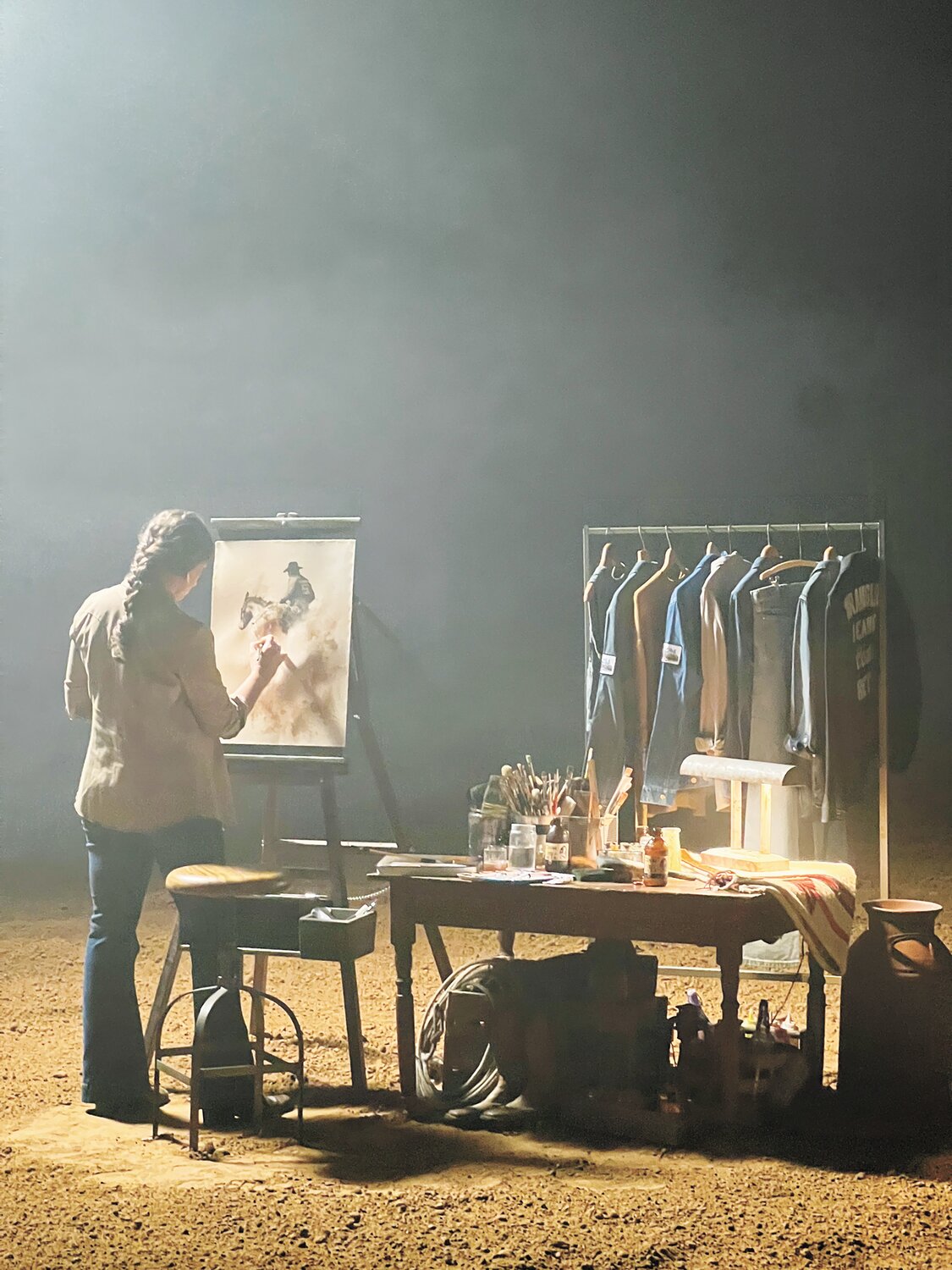


DODGEVILLE, Wis. — At her childhood farm in Door County, Caitlin Leline Hatch could be found in the stables with some equine friends and a sketchbook. Time spent sketching the horses and the way the sun reflected off the rural landscape of her home led her to create art for two of the most iconic brands of the American West, Coors Banquet and Wrangler.
Hatch is an award-winning watercolor artist who also owns Uplands Cheese in Dodgeville with her husband, Andy. The two manage the family dairy farm that has been in operation for over a century, milking 160 cows that they rotationally graze and seasonally calve. All of the milk from their farm goes to Uplands Cheese, where it is made into the award-winning cheeses of Pleasant Ridge Reserve and Rush Creek Reserve.
“Our farm has been milking cows for over 100 years, and my husband and I feel a sense of responsibility to continue tending the land and preserving its natural beauty,” Hatch said. “We love the seasonality of farming, moving in rhythm with the natural world around us. We do our best to tend to the land and animals that inhabit it by practicing regenerative agricultural methods.”
The opportunity to paint for the two American brands came when an email appeared in Hatch’s inbox.
“I almost deleted it; it seemed too good to be true,” Hatch said. “When I saw Coors Banquet beer and Wrangler, I decided to respond. Soon after I was invited to a Zoom meeting with the creative team to learn more about their vision. From the first conversation, it was clear the project was a perfect fit for my painting style.”
Hatch was commissioned to create five paintings that featured one co-branded garment in each scene. Her efforts were to create pieces that celebrated the heritage, hard work and authenticity of the brands, characteristics that she grew up portraying in her art through her life on the farm.
“Life on the farm teaches patience, rhythm and observation, the same qualities I rely on when I paint,” Hatch said. “Farming also keeps me connected to the physical world: the way the light moves across a pasture, the smell of rain, the texture of the soil … Both farming and painting require care, humility and a willingness to work with, not against, nature.”
As part of the advertising campaign, Hatch had the unique opportunity to fly to Fort Worth, Texas, to paint at the Cowtown Coliseum at the Fort Worth Stockyards as part of the video advertisement for the initiative.
“The arena was dark, except for a single spotlight above me, with dust swirling in the air and echoes of rodeo history all around,” Hatch said. “There was a tangible energy in that space — you could almost feel the generations of cowboys, riders and spectators who had filled it before. The energy and sense of place became part of the painting. It was a very different studio feel.”
After returning to her farm, Hatch completed the final paintings and shipped them to the printers. There, they were produced as a limited, numbered edition of giclée prints. Giclée prints are high-quality, archival prints created using an inkjet printer that employs permanent, pigment-based inks.
When the campaign launched, a handful of prints were released each day on the Coors website. They sold out within minutes.
While creating prints for Coors Banquet and Wrangler can be a daunting task, the creative team tasked Hatch with using an unconventional liquid medium for her watercolor — beer.
“I stayed up late that first night after that conversation, experimenting with beer and quickly learned that while it works similarly to watercolor, it dries slowly and becomes sticky,” Hatch said. “I had to be more deliberate with my process and learn to control its unpredictability. Those challenges ended up being part of its charm. The warm amber tone of Coors Banquet beer added a subtle golden glow that tied everything together beautifully.”
Collaboration between the creative team and Hatch was something that Hatch said stood out.
“The creative team encouraged me to stay true to my own process and style, which gave the work an honest foundation,” Hatch said. “I also think the concept of using beer as the painting medium carried a beautiful symbolism. It connected the artwork directly to the product and shared the idea of craftsmanship that runs through both painting and brewing.”
What started as an email turned into a journey of creativity, courage and connection. Linking two major American brands, constructed at a Wisconsin dairy farm, became a dream that reached all the way to New York City.
“I received a message with a photo of my painting towering over Madison Square Garden and booked flights for my 12-year-old daughter and me the next day,” Hatch said. “I was in total disbelief at first, then joy. Watching people rush by, realizing this image that began at my farm had reached the heart of New York City was surreal. It’s a moment I’ll carry with me forever.”
As a young artist who brought her paints wherever she went, seeing her work in the cultural capital of the world was never something she could have foreseen.
“I paint in a quiet studio on a rural farm,” Hatch said. “Most days I’m surrounded by cows and birdsong, not billboards and bright lights. To see my work on that scale, in a place like Manhattan, was beyond anything I’d ever imagined. It reminded me that art can travel far beyond the place it’s made.”
Life on the farm helps the watercolor artist continue to find inspiration in the landscape around her. Encouragement from her parents and grandparents at a young age helped her continue to express herself through her art. Hatch’s grandmother is responsible for her watercolor prowess, gifting Hatch her first set of watercolor paints.
“In high school I returned from a year abroad in Argentina,” Hatch said. “I hauled oil paints everywhere, only to discover how impractical it was to travel with wet canvases. My grandmother thought watercolor would be a better fit if I wanted to keep traveling.”
Hatch continues to create art, now drawing inspiration from the farm she works with her family.
“Farming has taught me how to slow down and really see, to pay attention to small details and subtle shifts in light, mood and movement,” Hatch said. “That same sensitivity translates directly into my paintings. The connection between working the land and creating art feels seamless; both are about patience, care and stewardship.”
 |
 |
 |
 |
Share with others


Comments
No comments on this item Please log in to comment by clicking here