
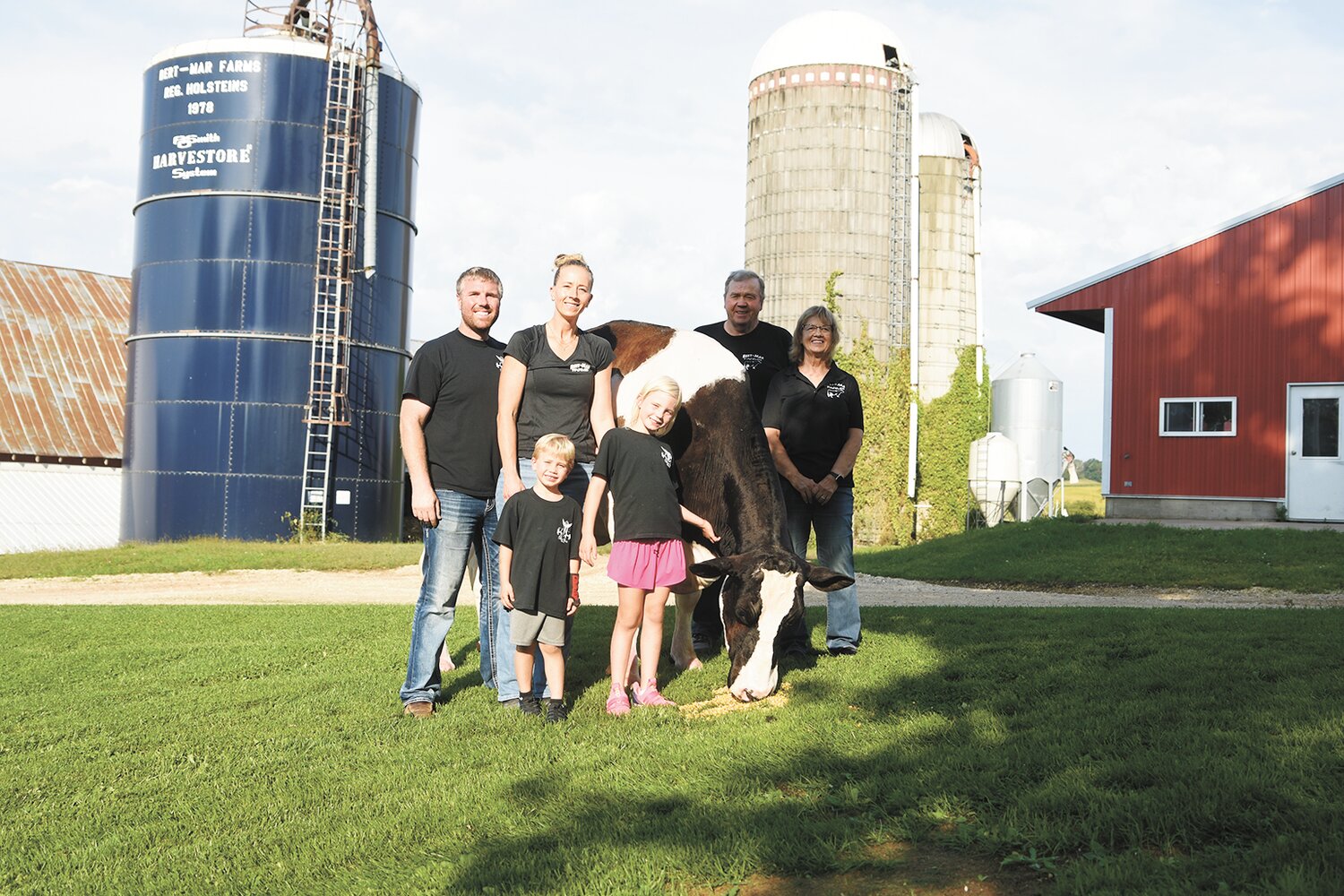


OSSEO, Wis. — A typical dairy cow does not live to be 18 years old, but Luck-E Advent Asia-ET EX94 is no ordinary cow. On Sept. 1, the award-winning Holstein celebrated such a birthday at Bert-Mar Farms in Trempealeau County, where she remains a cornerstone of the operation and has impacted the breed itself through her remarkable genetics.
“She’s quite the cow,” Allan Lundberg said.
Asia is a former Illinois Cow of the Year, Holstein International’s Red Impact Cow of the Year in 2020, and a three-time Holstein International Reader’s Choice Red Impact Cow of the Year.
Bert-Mar Farms purchased Asia in 2015 from Luck-E Holsteins in Illinois, but the cow has never been milked in the farm’s 88-stall tiestall facility. Asia was past the milking chapter of her life before making the move to Osseo where the Lundberg family currently milks 110 cows. Since joining Bert-Mar Farms, the Lundbergs have flushed her as a donor dam to grow elite genetics that are sold across the globe.
“Asia had plenty of good records before she got here,” Lundberg said. “But she did not have to milk. That’s when you lose cows, through the calving process.”
With the embryo transfer process, there is less stress on her, he said.
When Allan’s daughter, Erica Lundberg, joined the fold at Bert-Mar Farms, the family was looking for ways to develop elite genetics to improve the herd and create merchandising opportunities. That started with building a professional relationship with Matt Engel of Luck-E Holsteins.
“I knew how great Matt and Joe (Engel) had been with their cows,” Erica said. “I wanted to get some of their genetics on our farm. Thankfully, Matt offered us Asia’s sister, Atlanta, first, and then we purchased Asia and another powerhouse cow, Kandie. Luck-E prides itself on selling its best, and the Asia line of genetics has been incredible.”
With those cows serving as pillars, Bert-Mar Farms rebuilt its herd after a battle with stray voltage nearly shut off the lights on the fifth-generation farm.
The Lundbergs began working with registered cows in the 1960s, and over the next 20 years, they formed a formidable herd in western Wisconsin.
“In the late 70s, we had a cow set a couple of state records, and we had someone offer to buy this old cow from us for a lot of money,” Allan said.
Allan said no because he wanted to keep her home to begin ET, which was in infancy at that point.
“You get these elite cows, do embryo work on them and either make money or make a nice herd, so I thought we could do that ourselves,” he said.
The decision to turn down a big check and pursue an emerging practice prompted a conversation between Allan and his father.
“He (my dad) just hung up on me,” Allan said. “It took him many years to forgive me, but it was a good decision and has really helped us get to where we are.”
1981 marked the first year that Bert-Mar Farms began working with ET.
“I had been reading about embryo transfers for a few years and the vets came in from southern Wisconsin,” Allan said.
Allan picked up the veterinarians from nearby Strum as the procedure required a certified veterinarian at that time.
“We were active in embryo transfer after that,” Allan said. “It was challenging early with unconventional embryo transfer, but it has gotten easier with IVF (in vitro fertilization). But there wasn’t IVF when we started.”
The farm’s fight with stray voltage ultimately forced the Lundbergs to find another way to stay afloat.
“When we went through our issues with stray voltage, we pretty much lost our herd,” Allan said. “Asia, Atlanta and Kandie really brought us back and put us back on the map. Now with (World Dairy) Expo coming around every year, we still have people stopping in, mainly to see Asia. They see her and our herd. They know of us through these cows.”
Using the lineage of those animals, Bert-Mar Farms rebuilt its barn and has regained its footing in the dairy world.
“We went from horrible to classifying a couple of weeks ago being really fun,” Allan said. “Having Asia and the pedigree from her, Atlanta and Kandie, those animals have helped us tremendously. The deeper the pedigree, the higher the percentage of good ones, and those three have tremendous pedigrees. The scoring stays more consistent when we have multiple generations from those cows in our herd now.”
The Asia bloodline continues to impress people within the dairy industry, and that’s evident in the barn at Bert-Mar Farms.
“With our herd and her genetics, it’s been a complete 180 with her impact,” Allan said. “She was way ahead of her time with her modern stature and phenomenal udder. We can’t say enough about the impact she’s had on our farm, and the Holstein breed.”
 |
 |
 |
 |
Share with others


Comments
No comments on this item Please log in to comment by clicking here