
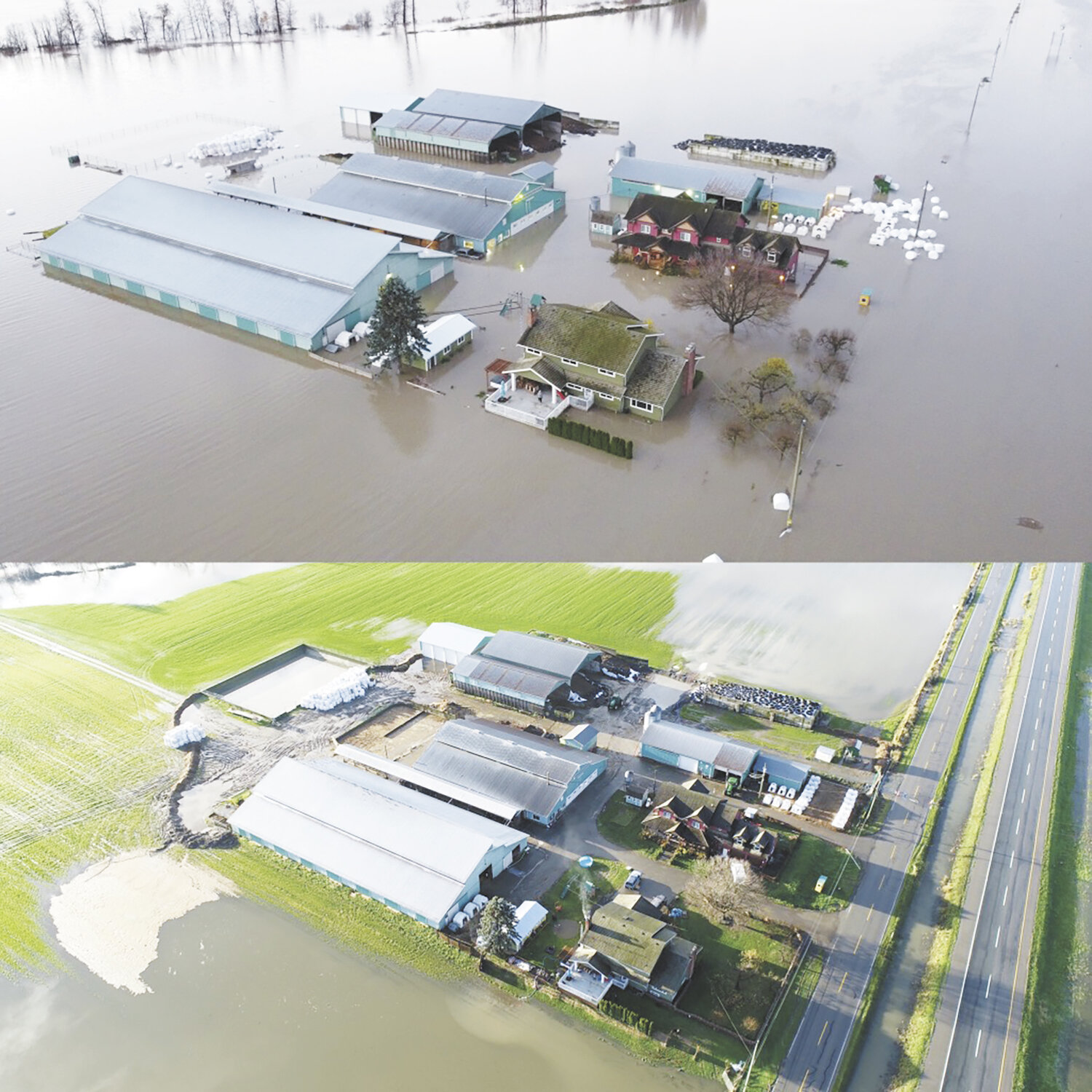


ABBOTSFORD, British Columbia — Heavy rains that fell over the Sumas Prairie in British Columbia’s Fraser Valley created a frightening sense of déjà vu for the region’s dairy farmers in mid-December.
Over six inches of rain fell over the region in a 24-hour period, Dec. 9-10, 2025. The flooding events were instigated when the nearby Nooksack River in Whatcom County, Washington, overflowed, spilling floodwaters into Canada’s Sumas Prairie.
“I’m a 3-time flood survivor now,” said dairy farmer Rudi Meier. “I’ve been through the floods in 1990, 2021 and now this one.”
Meier milks 200 cows with his brother, Karl, at U&D Meier Dairy #1 near Abbotsford.
Another Sumas Prairie dairy farmer, Matt Dykshoorn, milks 80 cows on his family’s B&L Dairy Farm. His farm which is also near Abbotsford, has also been affected by the valley’s flooding.
“We have had a few high-water events,” Dykshoorn said. “My dad remembers my grandpa telling him about a flood in 1951 that affected this area, and then we had the flood in 1990. Now we’ve had three or four high-water events in the last five years — 2021 and this one, and in 2020 we had a bit of a close call, but it didn’t do much damage.”
Both Meier and Dykshoorn said they were relieved when December 2025’s flooding fell just shy of the catastrophic water levels they experienced in 2021.
“This one wasn’t as bad as 2021 — that was an absolute nightmare — but when you have crazy rainfall like that, things are unpredictable,” Dykshoorn said. “The difference between this flood and 2021 was that there was less snowpack in the foothills of the mountains in Washington this time. The Nooksack reached the same levels in 2021, but there wasn’t the same volume of water behind that. The water spiked and then dropped, whereas in 2021 it spiked and held for probably a day and a half, then that massive volume of water is what breached the dikes in Canada.”
Both farmers were caught by surprise in 2021, and both ended up with their milking herds standing in several feet of water. This year, as the heavy rains began to make the Nooksack River’s water levels rise, both faced making decisions that would impact their herds.
“We’re in one of the more vulnerable areas, and last time caught a lot of us by surprise, how severe it was,” Dykshoorn said. “There was a lot of damage, lost livestock and poultry, equipment that didn’t get moved in time.”
With 2021’s floods fresh in their memories, Dykshoorn said fear of the unknown was real as the skies opened up last month.
“My newest barn was built a foot higher than my old barn, and the old barn was dry in 1990,” Dykshoorn said. “I was 6 years old in 1990, but I grew up hearing, ‘We’re never going to see a 1990 flood again.’ Well, in 2021, the water got three feet higher than 1990, which just blew everybody’s minds. We underestimated at that point, and we were watching it a lot closer this time.”
Dykshoorn recalled the helpless feeling he felt in 2021, watching his cows spend more than 24 hours standing in two feet of water.
“We couldn’t milk them, I threw hay into the pen, but they had no silage,” he said. “It was a pretty rough stretch. By the time the water got into the barns, our road was already under five feet of water.”
Meier said for his farm, the difference from 2021 was the direction from which the water approached the farm. In 2021, Meier said the water came straight from the north, while this time it broke more west of his farm.
“The water in our yard rose 2.5 feet in 20 minutes,” Meier said. “We were kind of concerned if there was more water coming. It came straight up from the backyard. We ran six 2-inch gas pumps pretty much for a week straight, and we had pumps in the basements of the houses. The barnyard was not as flooded, but we had a lot of surface flooding. It didn’t get to the milk cows this time, but last time it did — we had 3.5 feet of water in our milking facility.”
The decision of whether or not to evacuate must be made on a short timeline. Both Dykshoorn and Meier said they moved heifers to other locations as a precautionary measure.
“We made some calculations and decided to stay,” said Dykshoorn. “Our road is fairly low, so we have to make that decision before the water even gets to us, which is pretty tough. Once you’ve made the decision, you’re committed. It made for a lot of sleepless nights. Thankfully it stopped just short — the water made it into the dairy barns, the alleys were wet, but the stalls and feed mostly stayed dry.”
Meier was away from the farm, visiting his daughter on Vancouver Island, when the deluge started.
“We came home to 6 inches of water in the basement, because the sump pump couldn’t keep up,” Meier said. “(I was) trying to convince my wife that it wasn’t going to be as bad, when the first time I was so sure that nothing was going to happen, and then being blindsided. You try to keep your composure by having some faith.”
With an increasing number of high-water events, the farmers said they want to see the governments increase efforts to mitigate future incidents.
“We are seeing some pretty severe rain events, but being on the West Coast, that’s nothing new,” Dykshoorn said. “The Fraser Valley can handle six inches of rain. There are some high stream flows, but we can handle that. It’s when we have to handle another major river spilling its banks into our watershed that we become overwhelmed.”
Dykshoorn said he believes a lack of maintenance on the Nooksack is at the root of the problem.
“From what I understand, they used to dredge the Nooksack regularly in the low-water season,” Dykshoorn said. “There was a concrete plant that would excavate the gravel out and use it for their product. … They quit doing that sometime in the 80s or 90s. … The river used to be a deep channel, but now it just keeps filling up and the capacity is diminishing.”
The local and provincial governments were quicker to act in December 2025, Meier said.
“In 2021 the flood came on a Sunday; nobody was at the pumphouse and the pumps weren’t running,” Meier said. “They didn’t use the proper spillways to spill the water out to the lake bottom. It was a perfect storm, with too many mistakes made on the first day. This time, I will say, they did all the best they could. They have spent four years cleaning the rivers and ditches; they put backup generators on the pump stations.”
The two dairymen said the overall response from the Canadian federal government has been disappointing.
“(They are) not supporting British Columbia with enough money,” Meier said. “They have said they have plans of maybe by 2030 having a projected $1 billion pump station in place, but by 2030, we can have multiple floods.”
In the meantime, Dykshoorn said all they can do is be vigilant and prepared.
“Traditionally this has always happened in November; that is our high-risk period,” Dykshoorn said. “My dad and I were actually talking about it, the first week in December, how relieved we were to be done with November so that we didn’t have to worry about flooding anymore. Then here we get it in the second week of December. That tells us we’re never out of the woods until it gets really cold up in the mountains.”
 |
 |
 |
 |
Share with others


Comments
No comments on this item Please log in to comment by clicking here