


It was the middle of the night in 1985 as Ron Eustice stepped off a flight to Jakarta, Indonesia, into a sweltering paradise of 90% humidity and luscious vegetation. The next morning, in a meeting with business owner Tegoeh Soetantyo, a jet-lagged Eustice, who worked for Land O’Lakes Inc. in international business development, was met with a surprise.
“They said, ‘We want to import 20,000 U.S. Holsteins,’” Eustice said. “I looked at him and I said, ‘You’re serious?’ (He said) ‘Yes, we’re serious. We’re going to import 20,000 Holstein cattle and you’re going to help.’”
What eventually resulted was 12,000 U.S. Holstein heifers from the Midwest being exported to Indonesia, many under the U.S. government’s Dairy Termination Program, commonly called the whole herd buyout.
“They didn’t know anything about cows, and I thought it was probably over optimistic to think that 20,000 cows would ever come to Indonesia,” Eustice said. “But my job was to create business opportunities. My job was to sign contracts.”
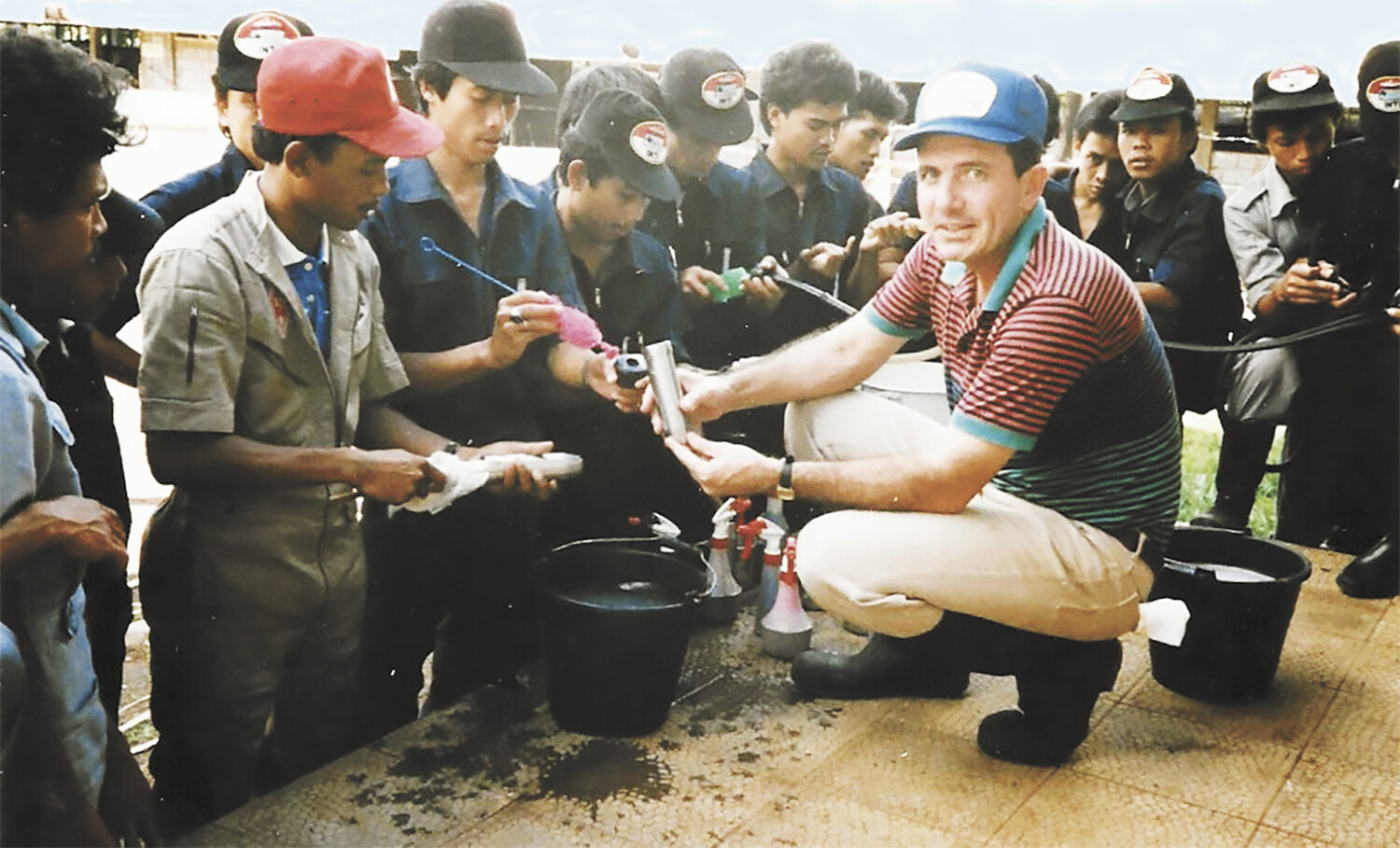
In the next years, Eustice and a team worked to build farms and train native Indonesians in modern dairy farming methods, with retired Midwestern dairy farmers visiting Indonesia to help train.
Soetantyo owned P.T. Mantrust, a food company with around 20 branches. One branch, Tirta Amerta Agung, in collaboration with a Dutch company, made condensed milk at a plant in Salatiga, a town of 200,000 at the base of an active volcano. The milk plant did not use local milk and was internationally importing powdered milk and reconstituting it. Condensed milk was a good product for their market since most rural Indonesians had no refrigeration.
The president of Indonesia, Suharto, wanted Soetantyo to stop importing milk powder and to import dairy cattle instead. According to the Encyclopedia Britannica, Suharto, who came to power in 1965 via a bloody military coup, encouraged foreign aid and Western investment to improve the economy as part of his “New Order,” successfully lowering inflation from 630% to 9%.
At the time, the Indonesian dairy industry was subsistence-based, featuring small farmers with one or two cows, which were Zebu or a cross between Zebu and Holstein. Holstein Friesians had been introduced by the Dutch while Indonesia was under their rule for about 350 years, first under the Dutch East India Company and then the Dutch government until 1949.
National Cooperative Business Association (CLUSA International), which Land O’Lakes had previously collaborated with, had recommended Land O’Lakes be P.T. Mantrust’s import partner.
To prepare, Eustice negotiated contracts and identified a location to build a large central breeding farm that would provide feed and services to some 70 separate units they planned to create.
From 1987 to the end of 1989, Eustice, his wife, Margaret, and their three children moved to Indonesia to oversee the project. Joining them were husband and wife veterinarians, Gene Monfore and Cathy Park. The herdsman, LeRoy Koppendrayer, his wife, Carolyn, and their four children had formerly dairy farmed near Princeton, Minnesota, before participating in the buyout and shipping 100 of their heifers to Ecuador.
The team coordinated the building of the main dairy at Tengaran, which was south of Salatiga. The main dairy was built at 2,000 feet of elevation on the site of a former garbage dump. Milking equipment was imported from Denmark.
In early 1987, the first load of 1,000 springing heifers arrived on a boat. Over the next months, the heifers arrived at a rate of 1,000 per month, then slowed to one boat every other month because the team could not keep up.
In the villages, the team coordinated the building of approximately 70 barns, each designed to accommodate 120 cows owned by 20 farmers. Each farmer was given six cows through the program. Services such as feed, insemination and veterinary work were provided by the central farm that housed 3,000 milking cows.
“It was a pretty big undertaking,” Koppendrayer said. “All the buildings were built by hand with hand tools, and the villages didn’t have electricity.”
Koppendrayer said they experienced cultural differences between themselves and the Indonesians. He believes the differences were connected to the climate.
“The culture was, if we don’t get it done today, we’ll do it tomorrow,” Koppendrayer said. “(Climate-wise) everything is green and everything’s warm all the time. … They were not in a hurry because tomorrow was going to be just the same as today.”
The main farm was tasked with growing feed for the entire project. The local farmers were required to buy their feed from the main farm. Koppendrayer said this was a challenge since the government did not want them to take away land that could grow food for the people.
The project contracted with local farmers to raise corn in rice paddies during the dry season. Corn was cut by hand, bound in bundles and carried on farmers’ backs to a pickup spot. They also fed sugar cane tops, molasses and casava flour.
Eustice and the team provided training to the new Indonesian farmers who had no dairy experience. Eustice learned the language and taught young men in groups of 20 to be trainers in the villages.
A challenge was that, in the Indonesian culture, they were expected to only train men. However, often the women were working with the cattle instead of the men.
Another challenge Eustice said, was financial. The average daily income of the villagers was around $1. The Indonesian government required Tirta Amerta Agung to guarantee $6 per day. With guaranteed money, the work incentive was lowered.
As part of the farmer development, over the three years Eustice’s team was there, about 30 retired Midwest dairy farmers came in small groups for six weeks to help train.
Eustice hired Indonesians to translate for the Midwesterners. Among these translators were Lilly Lockwood and Reni Fullen, both college students at the time.
Fullen and Lockwood said translating industry jargon words and phrases such as mastitis or colostrum was a challenge.
“One of the farmers was asking the local farmers when was a certain cow ‘in heat,’” Fullen said. “I did not know what he meant.”
Lockwood had similar experiences.
“We are dealing with language, so I had to make sure that I interpreted and translated what they really meant,” Lockwood said. “For example, you say here, ‘You really drive me crazy.’ … In Indonesian it doesn’t make sense.”
The pair also experienced American culture and slang. Fullen tried her first root beer float and remembers a Christmas party where turkey and ham were served.
Lockwood was assigned to translate for Minnesotan farmer Don Forner. After the experience, Forner invited Lockwood to attend the University of Minnesota for graduate school, which she did in 1992, living with his family on their dairy near Chaska. Forner even came back to Indonesia with his wife, Donna, to meet Lockwood’s parents so they would feel comfortable with her moving.
“I’m here because Don invited me,” Lockwood said. “It was meant to be that I met them. We had lifelong friendship. … His family is my American family.”
The import project was completed around 1990, but Koppendrayer returned to visit a few years later and found both success and failure.
“Thirty percent of the farmers that we trained … obviously were not going to succeed,” he said. “Thirty percent of them were doing fairly well, and 30% of them were doing really well.”
 |
 |
 |
 |
Share with others


Comments
No comments on this item Please log in to comment by clicking here