

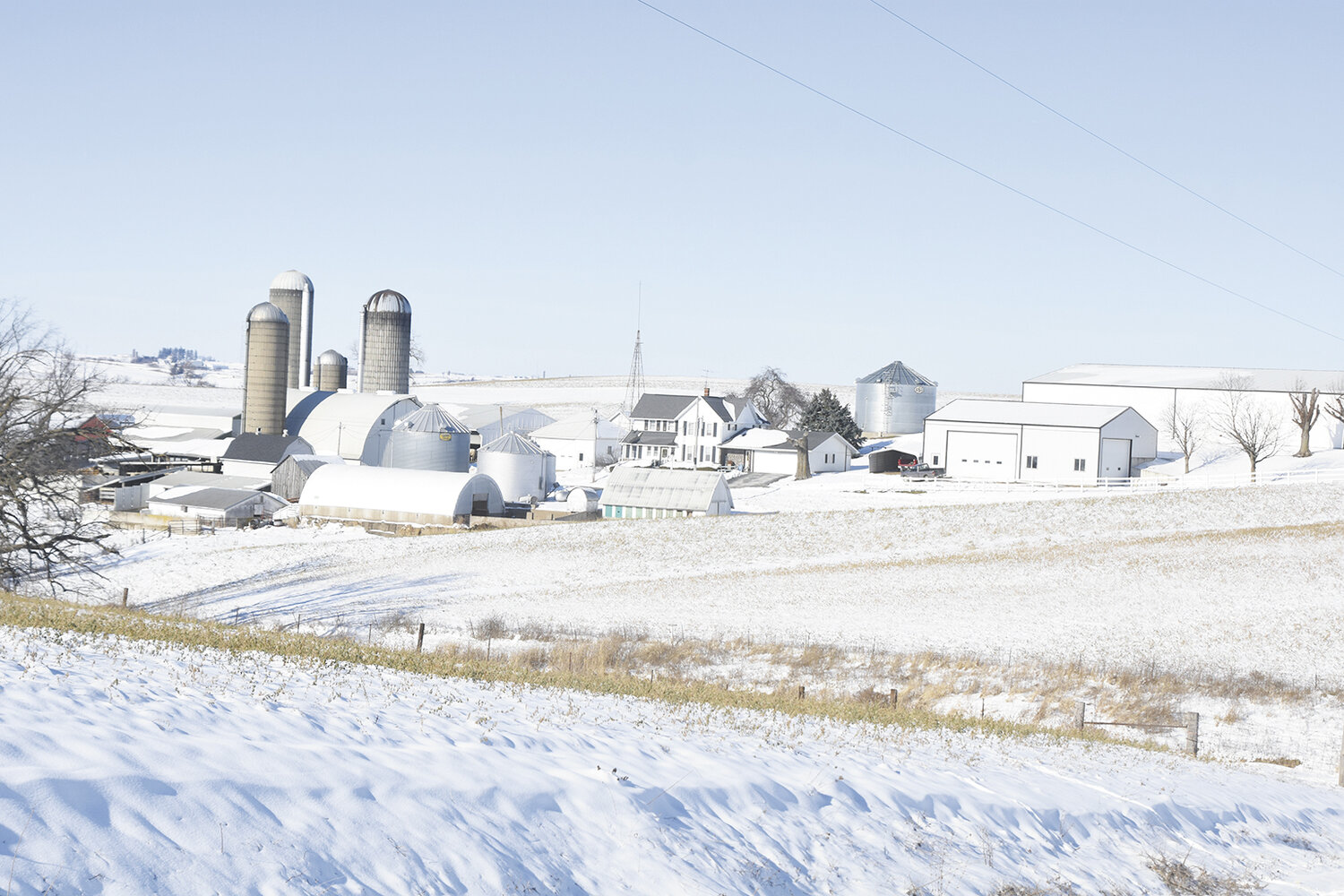


SPRAGUEVILLE, Iowa — Holsteins found a home inside the barn of the Heiar farm in the early 1920s. Now, more than a century later, Tom Heiar is continuing the family tradition of milking cows. Heiar is the fifth generation on the family farm, recently taking over for his father, Mark Heiar.
“There have been Holsteins and International tractors on this farm for about 100 years,” Mark said. “My mom was born in 1920, and she was just old enough to remember the truck coming down the lane with heifers in 1923. Her father bought between 9 and 12 registered Holsteins from eastern Wisconsin as the herd was started.”
For 26 years, cows were milked by hand, and their milk was sold as cream. But in 1946, disaster struck as a fire destroyed the milking barn.
“It was a big hip roof barn with redwood siding,” Mark said. “They were threshing and my grandpa and a neighbor were working together, and they were switching so one could go eat dinner. It wasn’t five minutes after they switched that my dad saw smoke coming from the barn. He got the bull and tied it up to a tree away from the fire, and it wasn’t long after that the roof fell in and the sides fell out.”
No livestock was lost, but the fire found plenty of fuel with over 100 loads of first-crop hay already in the haymow when the fire started.
As the fire burned, there was worry the house nearby might also catch fire. The cedar siding on the house was so hot that resin began seeping through the knot holes. Mark recalls the story of the local priest coming to the property while the barn burned and said a blessing on the family home.
“After he said that prayer, the wind began to turn,” Mark said. “A lot of people won’t believe that, but there’s power in prayer and the wind switched and came out of the north and went to the south away from the house. My dad was renting a farm a little over two miles from here, and when they were picking corn by hand the following year, they found shingles from the barn in his cornfield.”
With the milking barn destroyed, Mark’s grandfather sold his cows and waited to rebuild his herd. The heifers stayed at the farm, and after calving, were milked by hand for four years.
“Grandpa waited until 1950 to rebuild,” Mark said. “That’s when he built the barn here because he wanted better lumber. He had a sawmill and sawed all the lumber himself. He bought the round rafters out of Wisconsin and did a lot the work to rebuild the barn. He finished building it in 1953.”
By understanding what the farm has been through and the hard work it took to resurrect it, Tom shows an appreciation for continuing to keep the lights on in their family barn.
“There’s a level of pride that comes with hanging the milkers in this barn,” Tom said. “I know what my great-grandfather went through to build this back up.”
What started with a dozen heifers long ago, continues today with 60 cows. The Heiar family milks in a tiestall barn with a Jamesway floorplan and a maternity pen.
After Mark took ownership in December 1980, he installed a pipeline the following spring and added a barn cleaner in 1982. The Heiars continued to grow, adding 19 stalls in 1994, which brought the total to 45. Since that time, Mark and Tom have maintained the number of cows in the milking herd between 40-60, and value a cow’s longevity.
“I look at how long I can have the cow here,” Tom said. “I think you make more money off longevity than trying to push a cow too hard and then it’s done in just a few lactations. We have some here that are going on their ninth lactation. If I can help them get over six lactations, that’s a plus.”
Tom also speaks about how their tiestall barn helps the farm continue to have cows with more lactations and why that is a focus.
“With the tiestall barn, you can baby the cows a little more,” Tom said. “It’s always warmer in the wintertime. You don’t have to let them out if you don’t want to. As long as I can keep the cow around and she’s good on her feet and in good health, why sell her? She’s easier to keep around than bringing in a brand-new heifer.”
Now taking over the milking herd, Tom has plans to help improve production through genetics. To aid in that, the younger Heiar completed an A.I. course put on by Select Sires this past spring.
“I loved learning how to do A.I.,” Tom said. “It’s just easier to do it on my own when needed instead of having to call the breeder to come out for one cow. We can be more efficient, and it allows the breeder to do more with their own time.”
Tailoring genetics to increase productivity is one way that Tom is putting his own stamp on his family legacy. This is a legacy that he grew up with, and one he hopes can teach important characteristics to his own children, boys ages 3 and 1.
“I’m proud my boys have the opportunity to be on the farm,” Tom said. “It’s unique, really. Having the opportunity to be in the same exact place as my family before me, I feel it carries a little bit more.”
Mark said growing up on the family farm helped prepare all three of his children with a work ethic that can be appreciated by others off the farm.
“Tom is my youngest, and he’s always wanted to farm,” Mark said. “My girls would help on the farm when they were growing up. It helped build their work ethic. They have known what work is from a young age. It’s the foundation of their life.”
 |
 |
 |
 |
Share with others


Comments
No comments on this item Please log in to comment by clicking here